

Casualty 1900s (Review)
- Jan 18
- 4 min read

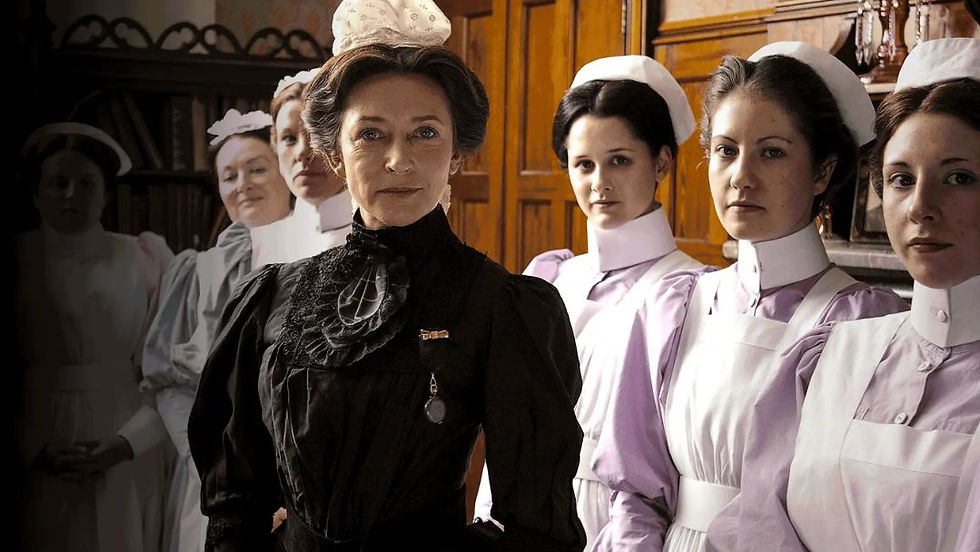
The turn of the 20th century was a time of radical change, where the Victorian past collided with the scientific future. Casualty 1900s—broadcast in the United States and internationally as London Hospital—is a British hospital drama that captures this transformation with unflinching realism. Far from a typical fictionalized soap opera, the series distinguishes itself by drawing every case, character, and event directly from the historical records of the London Hospital, including nurses' ward diaries and personal memoirs. This review explores how this BBC historical drama masterfully blends medical history with compelling human narratives.
Production Overview: From 1906 to 1909
Casualty 1900s originated as a historical spin-off of the long-running BBC medical series Casualty. The series was produced by Stone City Films and features direction by Bryn Higgins (episodes 1–3 of the 1909 series) and Mark Brozel (episodes 4–6 of the 1909 series).
The series is structured into three distinct installments, totaling ten episodes:
• Casualty 1906: A single pilot episode released on December 3, 2006.
• Casualty 1907: A three-episode series that aired between March and April 2008.
• Casualty 1909: A six-episode series that premiered on June 14, 2009, and concluded on July 19, 2009.
Set in the "Receiving Room" of the London Hospital in the poverty-stricken East End, the show is filmed with the frantic pace and high-stakes action characteristic of a modern-day Accident & Emergency (A&E) department.
Plot and Synopsis
The narrative follows the relentless daily operations of the London Hospital as it struggles to serve a community plagued by infectious diseases, industrial accidents, and social unrest.
In Casualty 1907, the hospital explores radical new techniques, such as using ultra-violet light to treat skin diseases caused by unsanitary living conditions. It also highlights the financial fragility of the institution, featuring Chairman Sydney Holland's inspired fundraising campaigns to prevent bankruptcy.
By Casualty 1909, the drama shifts toward the social revolution gripping the East End. The hospital staff must contend with victims of anarchist bombings and the rising tensions of a city on the edge of modern upheaval. Throughout the series, the "gritty" medical cases range from syphilis and tuberculosis to horrific injuries resulting from self-abortions and gang violence.

The Pioneers: Main Characters and Cast
The series features a talented ensemble cast portraying real historical figures:
• Matron Eva Luckes (Cherie Lunghi): The formidable head of the hospital, described as running the institution with a "will of iron". She is a central figure in all three installments.
• Sister Ada Russell (Sarah Smart): Initially a nurse, she rises to become a Ward Sister and eventually works in the reception area. Her journey involves a struggle between her professional duties and her "forbidden romances".
• Nurse Ethel Bennett (Charity Wakefield): A dedicated probationer who dreams of becoming a doctor—a challenging but possible path for women at the time.
• Dr. Millais Culpin (William Houston): A doctor who enters into a secret alliance and romance with Ethel Bennett.
• Chairman Sydney Holland (Nicholas Farrell): The dedicated administrator fighting to keep the hospital afloat.
• Mr. Henry Percy Dean (Paul Hilton): A star surgeon whose brilliance is shadowed by a secret addiction to cocaine.
• Mr. Hurry Fenwick (David Troughton): A prominent surgeon at the hospital.

Portrayal of Edwardian Medicine
One of the most fascinating aspects of Casualty 1900s is its portrayal of Edwardian medical practices. The series highlights the era's pioneering spirit and its perilous limitations:
• Anesthesia: The show depicts the scandalous introduction of chloroform and ether, alongside the first standardized use of spinal anesthesia.
• Technology: The hospital utilized pioneering radiographers working with dangerous X-ray equipment. At the time, protection was inadequate, leading to radiation burns on the hands of pioneers like Ernest Wilson.
• Surgical Methods: Without electronic monitoring, doctors had to manually check pulses during surgery. Cardiopulmonary resuscitation was performed using the Silvester Method, which involved manually manipulating a patient's arms to stimulate breathing.
• Infection Control: In an era before penicillin, infections like scarlet fever and erysipelas were often fatal. The effectiveness of early anti-streptococcus serums is featured, notably when Nurse Bennett contracts scarlet fever from a patient.
Distribution and Critical Response
The series was a significant success for BBC One, with the first episode of Casualty 1907 attracting an average of 6.7 million viewers and a 27% audience share. The 1909 series was also broadcast on BBC HD.
In terms of distribution, the complete series was released on Region 2 DVD in the UK. Internationally, the series reached audiences in Europe, South Africa, the UAE, and Israel under the title London Hospital. While specific award names are not listed in the sources, the series is consistently referred to as "acclaimed".
Spin-offs and Related Media
As a spin-off of the modern-day series Casualty, the show is part of a larger television universe that includes Holby City and HolbyBlue.
🔖 Key Takeaways
🗝️ Historical Accuracy: The series is based entirely on real hospital records, diaries, and memoirs from the London Hospital.
🗝️ The "London Hospital" Identity: Outside the UK, the series is widely known and distributed as London Hospital.
🗝️ Medical Evolution: It provides a visceral look at the introduction of X-rays, anesthesia, and the challenges of medicine before antibiotics.
🗝️ Strong Cast: Features real-life historical figures like Matron Eva Luckes and Sydney Holland, portrayed by acclaimed British actors.
🗝️ Ten-Episode Run: The show consists of three distinct parts released between 2006 and 2009.
🗝️ Success: The series enjoyed high viewership on the BBC, peaking at over 6 million viewers.
🌐 External sources


Keywords: Casualty 1900s
Casualty 1900s





Comments