

Grey's Anatomy TV Series Medical Review (S1E4 Review)
- Feb 26
- 7 min read
Updated: Mar 4
Listen up, people. Intimacy isn't just a five-syllable word for what happens behind closed doors; in this hospital, it’s what happens when you’re the first person a patient sees at 5:00 AM. Whether you’re dodging "McDreamy" in the elevator or trying to figure out if your roommate used your toothbrush, the lines between professional and personal get blurred fast. We’re surgeons—we’re experts at opening people up, but sometimes the hardest part isn't the incision; it’s dealing with the history, the secrets, and the humanity inside.
Today’s shift brought us a "Hell-raiser" in the ER with a head full of hardware and a history of dizzy spells. We also saw a hospital legend—one of our own—return with a significant abdominal mass and progressive jaundice. Meanwhile, on the floor, an older gentleman presented for a procedure involving his reproductive system, though he seemed more interested in our intern's modeling portfolio than his own recovery. And, in a quiet corner of the city, we’re managing the progressive cognitive decline of a surgical titan who remembers the OR better than her own daughter.
Grab your coffee. Let’s go to work.

The "Human 2x4"

Diagnosis
Sharp force trauma and Hypothalamic Brain Tumor.
Definition
Sharp force trauma refers to physical injuries caused by pointed or sharp objects. A hypothalamic tumor is an intracranial growth in the region of the brain responsible for hormone regulation and autonomic function. Manifestations include headaches, endocrine dysfunction, and personality changes. Prognosis depends on the tumor's malignancy and surgical resectability. (Note: This definition is based on real-world medical knowledge and is not explicitly in the sources).
Patient
Jorge Cruz.
Case Summary
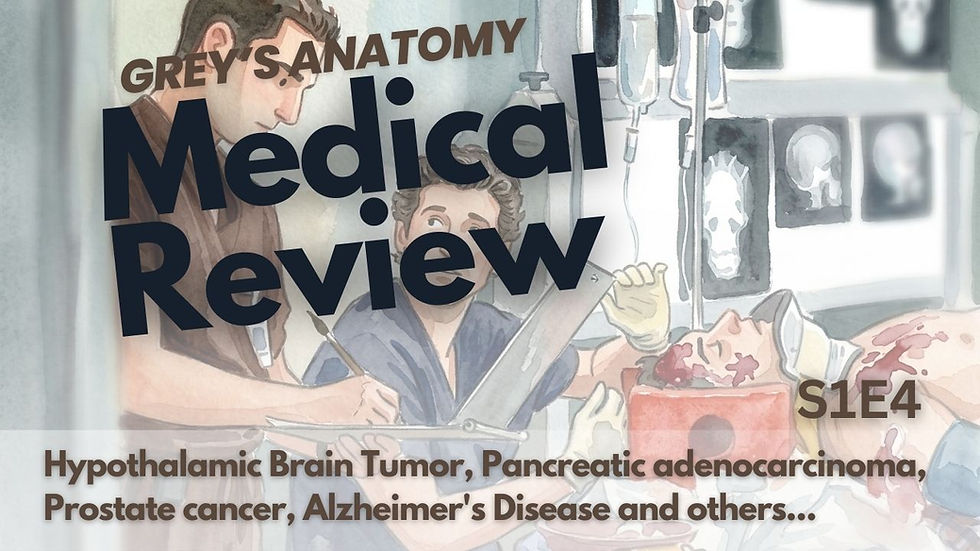
Jorge arrived in the ER conscious but blind after falling down stairs while holding a nail gun, resulting in seven nails fired into his skull. While the nails were successfully extracted, Meredith’s "gut feeling" about his pre-fall vertigo led to an MRI. The scan revealed a tumor near his hypothalamus. Faced with a choice between 10 years of life with a different personality or 3-5 years of being "himself," Jorge and his wife chose the surgery.
Care Team
Derek Shepherd, Meredith Grey, George O'Malley, Alex Karev.
Treatment
Controlled extraction of foreign bodies (nails) and tumor resection.
What they did wrong
Inappropriate Patient Influence: Meredith Grey crossed professional boundaries by aggressively trying to persuade Jorge’s wife, Zona, to choose the less invasive radiation treatment over the surgery. She argued that "10 bad years" (where Jorge might lose his personality) were worse than "5 good years," despite it being the patient's choice.
Inter-professional Conflict: Meredith’s interference caused a conflict with her attending, Derek Shepherd, who had to apologize to the wife for her behavior .
What they did right
Identifying Underlying Causes: Meredith correctly suspected that the fall wasn't a simple accident. She investigated Jorge's history of headaches and dizziness, which led to the discovery of the brain tumor that likely caused the fall.
Contraindication Awareness: The doctors correctly identified that they could not perform an MRI while the metal nails were still in Jorge's head, as the "giant magnet" would be dangerous.
Informed Consent: Derek Shepherd provided a thorough explanation of the risks, explicitly stating that removing the tumor could result in the loss of Jorge’s memory and personality.

The Hospital Institution
Diagnosis
Pancreatic adenocarcinoma.
Definition
A highly aggressive malignancy of the pancreas. It often presents with jaundice, weight loss, and abdominal pain. Because it is frequently diagnosed at an advanced stage, the prognosis is often poor, necessitating palliative care. (Note: This definition is based on real-world medical knowledge and is not explicitly in the sources).
Patient
Elizabeth "Liz" Fallon.
Case Summary
A former nurse at the hospital and longtime scrub nurse for Ellis Grey, Liz returned not for a Whipple procedure, as Cristina hoped, but to die. Despite Cristina’s aggressive attempts to intervene when Liz’s liver enzymes spiked, it became clear the patient was DNR (Do Not Resuscitate). Liz used her final hours to share insights about Ellis Grey before coding; Burke eventually had to physically stop Cristina from continuing useless compressions.
Care Team
Preston Burke, Richard Webber, Cristina Yang, Dr. Pinosky.
Treatment
Palliative care and previous radiation.
What they did wrong
Violating a DNR Order: When Liz coded, Cristina Yang ignored her DNR (Do Not Resuscitate) status. Cristina attempted to call a code and began chest compressions even after being told multiple times to stop.
Dehumanizing the Patient: Cristina initially viewed Liz only as a "Whipple" (a surgical procedure) she wanted to perform, rather than a person, and expressed frustration that the patient was only there to die, calling it a "waste of time".
What they did right
Upholding Patient Rights: Dr. Burke and the nursing staff (Tyler) acted correctly by physically stopping Cristina from continuing resuscitation, thereby honoring the patient's legal and ethical right to a natural death.
Palliative Care: The hospital correctly provided palliative care and radiation to manage her pain (level 3) and symptoms rather than pursuing futile, aggressive surgeries.

The Modeling Critic

Diagnosis
Prostate cancer.
Definition
Malignant growth in the prostate gland. Common manifestations include urinary frequency or obstruction. Treatment often involves surgery, which carries risks of impotence if pelvic nerves are damaged. (Note: This definition is based on real-world medical knowledge and is not explicitly in the sources).
Patient
Rick Humphrey.
Case Summary
Rick was scheduled for a biopsy that confirmed localized cancer. However, he refused to let Izzie Stevens treat him because he recognized her from a lingerie magazine. The attending, "Harry Manco" Victor, intended to perform a radical prostatectomy without regard for nerve-sparing. Bailey and Izzie advocated for the patient’s quality of life, eventually forcing Victor to allow Bailey to perform a nerve-sparing procedure.
Care Team
Harry Victor, Miranda Bailey, Izzie Stevens, George O'Malley.
Treatment
Nerve-sparing prostatectomy.
What they did wrong
Ignoring Patient Discomfort: Mr. Humphrey was extremely uncomfortable with Izzie Stevens being his doctor because he had seen her in a lingerie magazine. Despite his explicit request for another doctor, Dr. Bailey insisted Izzie stay on the case, which ignored the patient's right to feel comfortable with his provider during an intimate procedure.
Prioritizing Personal Schedule: The attending urologist, Dr. Victor (nicknamed "Harry Manco"), wanted to perform a radical prostatectomy that would leave the patient impotent simply because a nerve-sparing surgery would take longer and interfere with his "tee time".
What they did right
Quality of Life Focus: Dr. Bailey and Izzie advocated for nerve-sparing surgery. In modern medicine, preserving the patient's quality of life (such as sexual function) is a standard priority if it does not compromise the removal of the cancer.
Advocacy: Bailey offered to finish the surgery herself to ensure the nerves were saved, prioritizing the patient's long-term well-being over the attending's schedule.

The Legend in the Shadows
Diagnosis
Alzheimer's Disease.
Definition
A progressive, neurodegenerative disease characterized by the accumulation of amyloid plaques and tau tangles in the brain. It manifests as memory loss, disorientation, and cognitive decline. There is currently no cure, and management focuses on long-term care. (Note: This definition is based on real-world medical knowledge and is not explicitly in the sources).
Patient
Ellis Grey.
Case Summary
A world-renowned surgeon now residing in a long-term care facility. Her condition is a closely guarded secret that only Meredith knows. During a visit, she displays clear memory deficits, confusing the past and present, though she briefly recalls Liz Fallon with fondness.
Care Team
Staff at Roseridge Home for Extended Care.
Treatment
Long-term care.
What they did right
Early Diagnosis and Specialized Care: The sources indicate she was diagnosed early and placed in a specialized facility (Roseridge) for extended care, which is the standard of care for managing progressive dementia.
Patient Privacy: Ellis reportedly made "contracts" to ensure her condition remained private, which, while difficult for her former colleagues, respects her autonomy and desire for privacy regarding her health.

The Bumped Case

Diagnosis
Not specified (implied chronic pain).
Definition
A cordotomy is a surgical procedure that disables pain-conducting tracts in the spinal cord to provide relief from severe, intractable pain. (Note: This definition is based on real-world medical knowledge and is not explicitly in the sources).
Patient
Unnamed.
Case Summary
Derek Shepherd was scheduled to perform this procedure, but it was rescheduled to accommodate the emergency intake of Jorge Cruz.
Care Team
Derek Shepherd.
Treatment
Cordotomy.

The "Scut Work" Specials
Diagnosis
Not specified (post-surgical bowel management).
Definition
A colostomy is a surgical opening (stoma) in the abdominal wall that allows waste to leave the body from the colon into a bag. Regular bag changes are required to maintain hygiene and skin integrity. (Note: This definition is based on real-world medical knowledge and is not explicitly in the sources).
Patient
Two unnamed patients.
Case Summary
Alex Karev spent his shift performing "scut" by changing colostomy bags for these patients every 15 minutes.
Care Team
Alex Karev.
Treatment
Colostomy care and bag maintenance.
Colostomy Patients
Alex Karev complained about two patients who needed their colostomy bags changed every 15 minutes.
Wrong: Karev showed a significant lack of empathy and professional conduct by complaining about basic post-operative care.
Right: The frequent changing of the bags was necessary for the patients' hygiene and skin health, which the staff was correctly monitoring.

🔖 Key Takeaways
🗝️ In this Grey’s Anatomy S1E4 Medical Review, the episode explores how brain tumor decisions, DNR ethics, prostate cancer surgery choices, and Alzheimer’s care expose the fragile boundary between medical skill and emotional judgment.
🗝️ Meredith’s intuition uncovers a hypothalamic brain tumor, proving strong diagnostic instincts matter—but her attempt to influence treatment decisions highlights ethical limits in patient autonomy.
🗝️ Cristina’s violation of a DNR order reveals how ambition can override compassion, while Burke and the staff reinforce the legal and ethical necessity of honoring end-of-life wishes.
🗝️ Bailey’s advocacy for nerve-sparing prostate cancer surgery emphasizes quality of life over convenience, showing that patient-centered care must outweigh personal schedules.
🗝️ Across every case, the episode underscores that true medical excellence isn’t just technical precision—it’s respecting dignity, consent, and humanity in every decision.
Keywords: Grey's Anatomy Medical Review S1E4
Grey's Anatomy Medical Review S1E4


Comments