

Grey's Anatomy TV Series Medical Review (S2E17)
- Mar 29
- 6 min read

Listen up, people. If you thought your last 24-hour call was a nightmare because the cafeteria ran out of coffee, sit down. We’re talking about a shift that redefined "high stakes" at Seattle Grace. We had a Code Black—an unexploded projectile inside a patient—which meant the OR was a literal powder keg. While one team was trying not to get blown to "pink mist," another was battling a massive intracranial bleed in a surgical resident’s husband. Down in OB, a usually unflappable resident was stalled in active labor, refusing to push while her world crumbled around her. To top it off, the Chief of Surgery himself looked like he was heading for a cardiac consult after collapsing under the pressure.
Here is the breakdown of the rounds you never want to attend.

Large Sucking Chest Wound

Diagnosis
Large sucking chest wound (Open Pneumothorax) with retained unexploded ordnance.
Definition
An open pneumothorax occurs when a hole in the chest wall allows air to enter the pleural space directly from the environment. This causes the lung to collapse and shifts the mediastinum, potentially leading to tension pneumothorax. When caused by a projectile like a rocket or bazooka round, the prognosis is extremely guarded due to massive tissue destruction and the risk of explosion.
Patient
James Carlson.
Case Summary
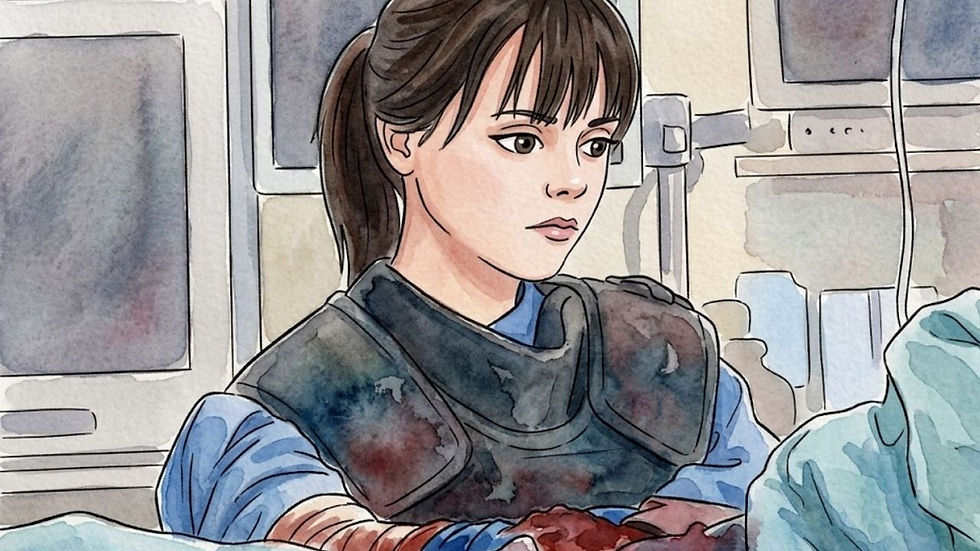
James arrived with an unexploded bazooka round in his chest. A paramedic, then Meredith Grey, had to manually hold the wound to prevent exsanguination. Because they were over the main oxygen line, the team had to move the gurney slowly to a safer OR.
Care Team
Preston Burke, Meredith Grey, Cristina Yang.
Treatment
Foreign body extraction (the bomb) followed by a thoracotomy to repair the internal damage.
What They Did Wrong
The most significant medical and safety error was Meredith Grey placing her hand inside the patient to replace the paramedic who fled, effectively becoming a human "plug" for a live bomb. In modern emergency protocols, medical personnel are typically required to evacuate until a bomb squad (EOD) secures the area, rather than performing surgery around a live explosive. Additionally, they moved the patient on a gurney while he was still being manually ventilated and had a hand inside him, which increased the risk of the bomb shifting.
What They Did Right
The team correctly identified that they were operating directly above the main oxygen line of the hospital, which would have caused a massive explosion if the bomb had gone off. Moving the patient to a different OR was a necessary step to mitigate hospital-wide destruction. Dr. Burke also followed the correct procedure for a thoracotomy and foreign body extraction once they were in a safer location, ultimately saving the patient’s life.

Depressed Skull Fracture & Epidural Hematoma
Diagnosis
Depressed skull fracture and Epidural Hematoma.
Definition
A depressed skull fracture occurs when a segment of the skull is sunken inward, often causing brain injury. An epidural hematoma is a build-up of blood between the dura mater and the skull, usually caused by a rupture of the middle meningeal artery. Without immediate surgical decompression (craniotomy), it leads to increased intracranial pressure, herniation, and death.
Patient
Tucker Jones.
Case Summary
Tucker (Dr. Bailey’s husband) was involved in a car accident and arrived with his skull open. During surgery, he became unstable and nearly died, but the team managed to re-stabilize him.
Care Team
Derek Shepherd, Cristina Yang.
Treatment
Craniotomy for decompression and stabilization, plus resuscitation when he became unstable.
What They Did Wrong
Dr. Shepherd chose to operate during a "Code Black" (bomb threat), refusing to evacuate the hospital. From a modern hospital safety perspective (and even within the show's context), continuing a complex surgery near a live explosive puts the patient, the surgeons, and the entire facility at extreme risk. Shepherd acknowledged that his surgical plan carried a high risk of the patient losing speech, suffering a hernia, or dying.
What They Did Right
Shepherd successfully performed a craniotomy and resuscitation when the patient became unstable and began hemorrhaging. In modern medicine, an epidural hematoma is a surgical emergency that requires immediate pressure relief (craniotomy), so the clinical procedure itself was the correct standard of care.

Pregnancy and Active Labor

Diagnosis
Pregnancy / Normal Spontaneous Vaginal Delivery (NSVD).
Definition
Pregnancy is the period in which a fetus develops inside a woman's uterus. Labor is the process of childbirth, starting with uterine contractions and ending with the delivery of the baby and placenta. If labor is stalled due to maternal distress or refusal to push, it can lead to fetal hypoxia or the need for an emergency C-section.
Patient
Miranda Bailey.
Case Summary
Bailey’s waters broke, and she entered active labor with contractions every 40 seconds. Terrified for her husband in surgery, she refused to push until George O'Malley stepped in as her "person" to coach her through it.
Care Team
Addison Montgomery-Shepherd, George O'Malley.
Treatment
Vaginal delivery.
What They Did Wrong
Dr. Bailey refused to push, a reaction triggered by the extreme stress of her husband (Tucker Jones) being in surgery during the bomb threat. While understandable, the sources note this was medically dangerous, as prolonged labor without pushing can lead to fetal distress. Dr. Montgomery-Shepherd pointed out that if Bailey did not push, an emergency C-section would be required, but no operating rooms were available due to the evacuation.
What They Did Right
George O’Malley used psychological intervention instead of medical force. He "soothed" her and used a stern "pep talk" to remind her of her strength, which convinced her to labor effectively. This focus on the patient's emotional state to facilitate a safe vaginal delivery remains a key part of modern obstetric care.

Anxiety Attack
Diagnosis
Anxiety attack (Panic Attack).
Definition
A sudden episode of intense fear that triggers severe physical reactions when there is no real danger or apparent cause. Symptoms often mimic a myocardial infarction (heart attack), including chest pain, heart palpitations, and shortness of breath. Prognosis is excellent once the trigger is managed.
Patient
Richard Webber.
Case Summary
The Chief presented with symptoms that looked like a heart attack. However, his ECG was normal, and subsequent blood work confirmed it was an anxiety attack brought on by the hospital's crisis.
Care Team
Izzie Stevens, Alex Karev.
Treatment
Monitoring and diagnostic blood work to rule out cardiac enzymes.
What They Did Wrong
The source material does not indicate a medical error, but rather a misdiagnosis by the patient himself and the initial observers who thought his sweating and collapse were a myocardial infarction (heart attack).
What They Did Right
The doctors followed standard protocol by ordering an ECG and blood work (likely checking for cardiac enzymes). By performing these tests, they were able to rule out a cardiac event and correctly identify the issue as an anxiety attack. This "rule-out" method is still the gold standard for treating chest pain and respiratory distress today.

Hand Laceration
Diagnosis
Hand laceration.
Definition
A laceration is a wound that is produced by the tearing of soft body tissue. Hand lacerations require careful cleaning to prevent infection and sutures if the wound is deep enough to impede healing.
Patient
Hannah Davies.
Case Summary
After the trauma of holding a bomb inside a patient, Hannah ran and fell, cutting her hand.
Care Team
George O'Malley.
Treatment
Cleaning and stitches.
What They Did Wrong
As a paramedic, Hannah committed a professional/ethical breach by fleeing the OR while her hand was holding the explosive, which she admitted was an act of cowardice.
What They Did Right
George O’Malley provided basic wound care, cleaning the cut and applying stitches. This is the standard treatment for a non-deep laceration, then and now.

🔖 Key Takeaways
🗝️ A hospital-wide Code Black turns Seattle Grace into a high-risk battlefield, blending medical emergencies with life-threatening chaos.
🗝️ The bomb-in-the-chest case highlights extreme deviations from real-world emergency protocols despite a technically successful surgical outcome.
🗝️ The epidural hematoma storyline reinforces the urgency of neurosurgical intervention, even under unsafe conditions.
🗝️ Bailey’s labor emphasizes the importance of emotional support in obstetrics, showing how psychological care can directly impact physical outcomes.
🗝️ The Chief’s anxiety attack demonstrates the importance of proper diagnostic protocols to rule out cardiac emergencies.
🗝️ While the episode delivers intense drama, it frequently sacrifices safety realism for emotional and narrative impact.
Keywords: Grey's Anatomy S2E17
Grey's Anatomy S2E17


Comments