

Grey's Anatomy TV Series Medical Review (S2E21)
- Mar 29
- 6 min read

It’s another "dark and twisty" day at Seattle Grace, and if you haven’t heard the latest scuttlebutt from the morgue, word is that surgical fatalities come in threes—or in today's case, a predicted seven. As your Senior Resident, I’m here to tell you that while we all have our "juju" rituals—whether it’s a specific scrub cap or a lucky cup of hot cocoa—the science of the shift always trumps the superstition. We’ve had a morning that would make even the most seasoned attending want to hide in an on-call room. Let’s look at the board: we opened the shift with four consecutive losses on the table, followed by a series of presentations that would test anyone's clinical judgment. We saw a patient arrive coughing up significant amounts of blood, another struggling for every breath post-cardiac procedure, a trauma victim who was more concerned with repetitive rhyming than his head injury, and a woman with massive bruising who insisted that the timing of her surgery was more dangerous than her internal injuries.
Here are the rounds for the day.

Upper GI Bleeding & Cirrhosis

Diagnosis
Upper Gastrointestinal (GI) Bleeding secondary to Cirrhosis and Liver Failure.
Definition
This occurs when there is significant blood loss from the esophagus, stomach, or duodenum. In patients with cirrhosis, scarring of the liver causes portal hypertension, leading to esophageal varices—enlarged veins that can rupture and cause life-threatening hematemesis. The prognosis is often poor without a liver transplant.
Patient
Olive "Ollie" Warner.
Case Summary
A long-time friend and AA sponsor of the Chief, Ollie, arrived in the ER coughing up blood. She had a history of a failed Transjugular Intrahepatic Portosystemic Shunt (TIPS) procedure for esophageal varices. Because her liver was failing and her previous procedure failed, the team had to escalate.
Care Team
Richard Webber, Miranda Bailey, and George O’Malley.
Treatment
A portacaval shunt is a high-risk surgical procedure with a 50% survival rate designed to redirect blood flow and reduce pressure in the portal vein.
What was done wrong
While the surgery was successful, the sources highlight that Ollie was having an "emotional affair" with the Chief of Surgery, Richard Webber, which potentially clouded professional boundaries. Additionally, her previous TIPS procedure had already failed within a month, necessitating a high-risk portacaval shunt with only a 50% survival rate.
What was done right
The medical team correctly identified that her esophageal varices were rupturing because cirrhosis prevented blood from flowing through the liver. Today, as then, a liver transplant remains the only definitive cure for her condition. The emphasis on her six months of sobriety as a milestone for transplant eligibility remains a standard requirement in modern hepatology.

Pulmonary Embolism
Diagnosis
Pulmonary Embolism (PE).
Definition
A PE is a blockage in one of the pulmonary arteries in the lungs, usually caused by blood clots that travel from the deep veins in the legs (DVT). It can cause sudden shortness of breath, chest pain, and heart failure. If not treated immediately, the lack of oxygen (hypoxia) or strain on the heart can be fatal.
Patient
Denny Duquette, Jr..
Case Summary
Already hospitalized for congestive heart failure, Denny began struggling to breathe. The team suspected a PE as a complication from his previous cardiac surgery.
Care Team
Preston Burke, Alex Karev, Izzie Stevens, and George O’Malley.
Treatment
After an unsuccessful attempt to remove the clot via catheter, the team performed an emergency open-chest surgery to remove the embolism.
What was done wrong
The primary issue was the unprofessional personal involvement of the interns, particularly Izzie Stevens, who admitted she was falling in love with him. In a modern medical setting, having a romantic interest in a patient is a severe ethical breach and would usually result in the immediate removal of the doctor from the case. Furthermore, they initially attempted to remove the clot with a catheter, which failed, delaying the definitive open-chest surgery.
What was done right
The team was quick to recognize the symptoms of a PE—difficulty breathing and abnormal lung sounds—as a complication of his previous surgery. Using open-chest surgery to remove a massive clot (embolectomy) when catheter-based interventions fail is still a standard, albeit high-risk, life-saving procedure today.

Splenic Laceration & Fractured Leg
Diagnosis
Splenic Laceration and Broken Leg.
Definition
A splenic laceration is a tear or rupture in the spleen, often caused by blunt abdominal trauma. It is graded by severity (I-V); high-grade lacerations (III-IV) carry a massive risk of internal bleeding and often require a splenectomy (surgical removal) to prevent the patient from "bleeding out" or exsanguination.
Patient
Nikki Ratlin.
Case Summary
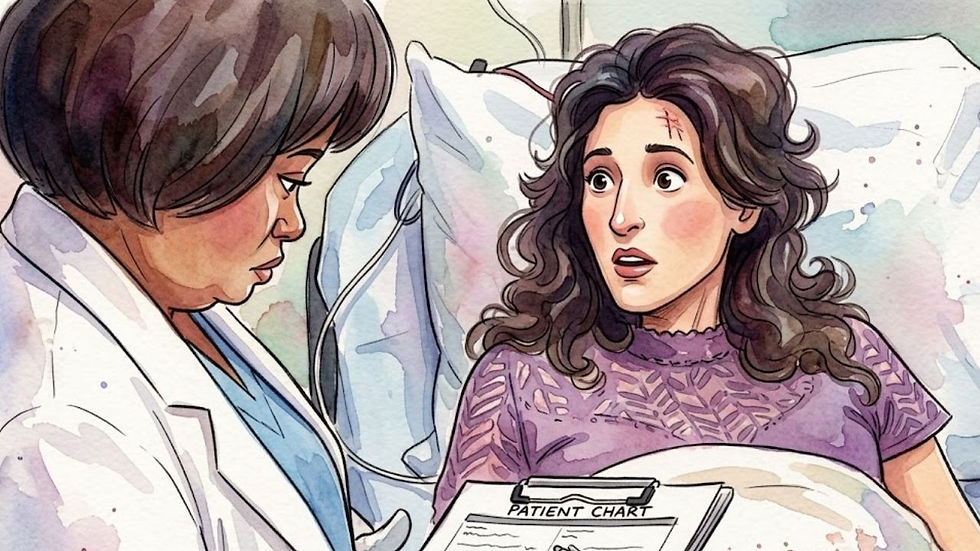
Nikki claimed she was hit by a tree that was struck by lightning, though she eventually admitted she fell out of the tree while spying on her ex-boyfriend. Despite a Grade III or IV splenic laceration, she refused surgery until after midnight because of her horoscopes and "signs".
Care Team
Miranda Bailey, Callie Torres, and Meredith Grey.
Treatment
Initial bone realignment and casting for her leg; however, she began to bleed out before her self-imposed midnight deadline and died despite resuscitation efforts.
What was done wrong
The medical team allowed the patient’s superstitions regarding her horoscopes to delay a life-saving surgery. Despite her having unstable blood pressure and a severe internal bleed (splenic laceration), they transferred her to the ICU to wait until midnight. This delay proved fatal; she "bled out" and died before they could operate. In modern trauma protocols, a Grade IV splenic laceration with hemodynamic instability is a surgical emergency that generally precludes waiting for a patient's preferred "lucky" time.
What was done right
The doctors were right to be skeptical of her story about being "struck by lightning," as she lacked the characteristic entry and exit wounds. Their persistence in finding the truth led to the discovery that she had fallen from a tree, which explained the internal bruising and led to the CT scan that diagnosed the laceration.

Intracranial Hemorrhage & Obsessive-Compulsive Disorder
Diagnosis
Brain Bleed (Intracranial Hemorrhage) and Obsessive-Compulsive Disorder (OCD).
Definition
A brain bleed involves bleeding within the skull, which increases intracranial pressure and can lead to permanent brain damage or death if the pressure is not relieved. OCD is a mental health disorder where a person has uncontrollable, recurring thoughts (obsessions) and behaviors (compulsions) that they feel the urge to repeat over and over.
Patient
Jesse Fannon.
Case Summary
A 32-year-old car accident victim who hit his head on a windshield. His OCD compulsions, which included repetitive rhyming and counting, made the clinical intake difficult. An MRI revealed a significant brain bleed.
Care Team
Derek Shepherd, Raj Sen (Psychiatry), and Cristina Yang.
Treatment
Emergency neurosurgery to address the bleed, during which the patient unfortunately passed away.
What was done wrong
The sources do not specify a clinical error, but his OCD compulsions (demanding everything be "clean, clean, clean") created friction and potential delays during his intake and preparation for surgery. He ultimately died during the procedure.
What was done right
The team correctly ordered a psychiatry consult to manage his OCD alongside his surgical needs. Using an MRI to quickly identify the brain bleed after a motor vehicle accident is the standard of care for head trauma, then and now.

🔖 Key Takeaways
🗝️ A devastating shift at Seattle Grace reinforces that medicine relies on science—not superstition—especially in high-risk, time-sensitive cases.
🗝️ Multiple critical cases, including GI bleeding, pulmonary embolism, and brain hemorrhage, highlight the complexity of emergency medical decision-making.
🗝️ Delays in life-saving treatment—particularly due to patient beliefs—can have fatal consequences, as seen in the splenic laceration case.
🗝️ Emotional involvement between doctors and patients compromises professional judgment and raises serious ethical concerns.
🗝️ Despite mistakes, the team demonstrates strong diagnostic instincts and adherence to core medical principles in identifying life-threatening conditions.
🗝️ The episode underscores that timing, objectivity, and ethical boundaries are just as vital as surgical skill in saving lives.
Keywords: Grey's Anatomy S2E21
Grey's Anatomy S2E21




Comments