

Grey's Anatomy TV Series Medical Review (S2E4)
- 7 hours ago
- 7 min read

Welcome to another day in the trenches, everyone. Grab your coffee—make it a double, gordo, no skinny lattes today—because the "denial" at Seattle Grace is currently deeper than the Atlantic. As your Senior Resident, I’ve seen it all: interns hiding their feelings, patients hiding their histories, and even world-class surgeons hiding from their own divorce papers.
Today’s shift is a masterclass in clinical presentations that aren't what they seem. We’ve got a world traveler presenting with syncope and palpitations despite a history of heart disease, a 26-year-old "sabichão" (smart-aleck) with a palpable abdominal mass and a lifelong history of respiratory issues, and—in true "McDreamy" fashion—a man who walked into the ER with a hole in his head and was remarkably calm about it. Oh, and one of our own is on the other side of the stethoscope, recovering from surgery and definitely not "fine," no matter what she says.
Let's scrub in and look past the drama to the science.

Pancreatitis and Cystic Fibrosis
Diagnosis
Cystic Fibrosis (CF) and Pancreatitis.
Definition
Cystic Fibrosis is a genetic disorder caused by mutations in the CFTR protein, leading to thick, viscous mucus that obstructs the lungs and pancreatic ducts. Pancreatitis in CF patients occurs when digestive enzymes become trapped, causing inflammation, scarring, and potentially masses or organ failure. The prognosis for CF has improved with modern care, but surgical intervention remains high-risk due to respiratory fragility.
Patient
Jeremiah Tate.
Case Summary
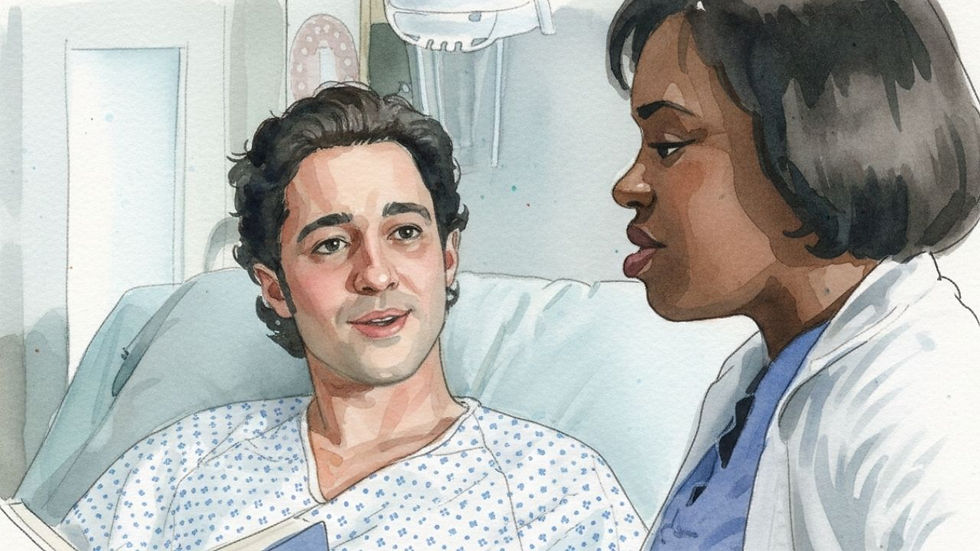
Jeremiah, a 26-year-old CF "survivor" and triathlete, presented with severe abdominal pain and a history of seizures. Imaging revealed a mass and an enlarged pancreas. Despite his high level of fitness, his lung function was a major concern for anesthesia. During a long, difficult surgery, Jeremiah suffered multi-organ failure and bradicardia. Despite a DNR order, the team attempted resuscitation before finally declaring him at 19:26.
Care Team
Dr. Miranda Bailey, Dr. Addison Montgomery-Shepherd (Medical Geneticist/OB-GYN), and Intern Meredith Grey.
Treatment
Exploratory laparotomy and pancreatectomy with intestinal re-routing.
What They Did Wrong
The most significant error in this case was Dr. Miranda Bailey’s attempt to resuscitate Jeremiah after he coded in surgery, despite him having a signed DNR (Do Not Resuscitate) order. While Bailey argued it was "merely good medical practice," her interns and colleagues correctly pointed out that Jeremiah had explicitly refused "extraordinary measures".
What They Did Right
The team correctly identified the risks of surgery for a patient with cystic fibrosis (CF), specifically that his lungs might not handle the anesthesia. They also utilized a multidisciplinary approach by bringing in Dr. Addison Montgomery-Shepherd for her specific research background in CF genetics.
Outside the sources: In modern medicine, the use of DNRs is strictly enforced to protect patient autonomy, and Bailey's actions would likely lead to severe legal and ethical repercussions today. Modern CF care has also advanced significantly with the use of CFTR modulators, which might have managed his condition more effectively prior to it reaching this critical surgical stage.

Munchausen Syndrome
Diagnosis
Munchausen Syndrome (Factitious Disorder Imposed on Self).
Definition
A mental disorder where a person repeatedly and deliberately acts as if they have a physical or mental illness when they are not really sick. This is often achieved by self-harm or ingesting substances to induce symptoms (like amitriptyline to cause arrhythmias or blue urine). The goal is to assume the "sick role" and gain attention rather than external incentives.
Patient
Kalpana Vera.
Case Summary
Kalpana presented with syncope and ventricular arrhythmias, claiming a history of rheumatic heart disease. After four hospitalizations in a year and a series of negative tests, Intern Cristina Yang grew suspicious. The "clinical pearl" appeared when the patient's urine turned blue; she had been secretly taking amitriptyline to induce her cardiac symptoms. She was eventually transferred to Psych.
Care Team
Dr. Preston Burke, Dr. Miranda Bailey, and Interns Cristina Yang and Izzie Stevens.
Treatment
Cardiac monitoring and electrophysiology mapping (prior to discovery), followed by psychiatric transfer.
What They Did Wrong
The primary surgeons, Dr. Burke and Dr. Stevens, initially failed to see past the physical symptoms, focusing purely on her cardiac history of rheumatic heart disease. They were misled by the patient's medical knowledge—she claimed to be a neuropharmacologist—which allowed her to manipulate the staff and hide the fact that she was intentionally inducing her own arrhythmias.
What They Did Right
Cristina Yang’s skepticism was the key to the correct diagnosis; she noted that Kalpana had been in four different hospitals in a year and that her tests were consistently negative. The diagnosis was ultimately confirmed by a toxicology screen that found amitriptyline, a drug that turns urine blue and causes ventricular arrhythmias.
Outside the sources: Modern protocols for Factitious Disorder (Munchausen) involve a rapid transition to psychiatric care once physical causes are ruled out, as Burke eventually did by transferring her to Psychiatry.

Traumatic Gunshot Wound (GSW)

Diagnosis
Gunshot Wound to the Head.
Definition
Penetrating trauma to the cranium. Survival and neurological function depend heavily on whether the projectile crosses the brain's midline or damages "eloquent" areas (speech, motor cortex). Debridement and dura repair are essential to prevent infection and CSF leaks.
Patient
Samuel Linden.
Case Summary
In a bizarre presentation, Samuel arrived walking and talking despite a 22 caliber wound to the head from a "cleaning accident". CT scans confirmed the bullet did not cross the midline, which explains his preserved function. The case took a turn when it was revealed that his wife actually shot him after discovering his infidelity.
Care Team
Dr. Derek Shepherd and Intern Alex Karev.
Treatment
Debridement and dura repair.
What They Did Wrong
The surgical interns, particularly Alex Karev, were dismissive of the patient's symptoms because he was "walking and talking" despite claiming to have a bullet in his head. They initially treated him as a psychiatric case rather than a trauma patient, which delayed the confirmation of a life-threatening injury.
What They Did Right
Dr. Derek Shepherd performed a proper neurological assessment and used a CT scan to map the bullet's path, confirming it did not cross the brain's midline. His surgical plan—debridement and dura repair while leaving the bullet in place—is consistent with modern neurosurgical practices for stable fragments.
Outside the sources: Today, any report of a gunshot wound would trigger an immediate trauma activation protocol (Level 1 or 2 trauma), ensuring a full team is present before the patient is even fully evaluated, preventing the "casual" intake seen in the episode.

Alzheimer's Disease and Hepatic Tumor
Diagnosis
Alzheimer's Disease and Benign Liver Tumor.
Definition
Alzheimer's is a progressive neurodegenerative disease characterized by cognitive decline and memory loss. Benign liver tumors (like focal nodular hyperplasia) are non-cancerous growths that may require resection if they cause pain or grow large enough to risk rupture.
Patient
Ellis Grey.
Case Summary
Ellis was post-op on day three following a tumor resection. Her recovery was complicated by her Alzheimer's, which caused her to shift between realities—sometimes believing she was still a working surgeon and other times recognizing her surroundings.
Care Team
Dr. Miranda Bailey and Interns Alex Karev, George O'Malley, and Izzie Stevens.
Treatment
Tumor resection (completed) and post-operative monitoring.
What They Did Wrong
The hospital failed in its duty of supervision for a patient with advanced Alzheimer's who was post-operative on day three. Ellis was able to wander the halls multiple times, even finding her way into the operating room area because the intern assigned to her (George O'Malley) kept "losing" her.
What They Did Right
Chief Webber correctly identified that Alzheimer's patients require environmental stability and a consistent caregiver to prevent agitation and confusion.
Outside the sources: Modern "memory care" units in hospitals use specialized wristbands, bed alarms, and locked wards to prevent "elopement" (wandering), which was a major safety failure in this case.

Ectopic Pregnancy (Post-Op)

Diagnosis
Ruptured Ectopic Pregnancy (Post-salpingectomy).
Definition
An ectopic pregnancy occurs when a fertilized egg implants outside the uterus, most commonly in a fallopian tube. If it ruptures, it is a life-threatening emergency. A salpingectomy is the surgical removal of the affected fallopian tube.
Patient
Cristina Yang.
Case Summary
Intern Cristina Yang was post-op on day three following a unilateral salpingectomy. She attempted to return to work early despite a fever of 38-39°C and ignoring her physical limits. Eventually, the physical and emotional stress led to a significant breakdown, requiring sedation.
Care Team
Dr. Addison Montgomery-Shepherd, Dr. Miranda Bailey, and Interns Meredith Grey, Izzie Stevens, and George O'Malley.
Treatment
Post-operative care following salpingectomy.
What They Did Wrong
Cristina herself was the primary obstacle to her own treatment. She lied to her doctors about having a fever, removed her own catheter, and attempted to return to work just three days after major abdominal surgery for an ectopic pregnancy.
What They Did Right
Dr. Bailey acted correctly by forcing Cristina to remain a patient and stay in bed until her vitals (specifically her temperature) normalized.
Outside the sources: While modern "Enhanced Recovery After Surgery" (ERAS) protocols encourage walking shortly after surgery, they do not support returning to the high-stress, high-activity environment of a surgical residency within 72 hours of an invasive procedure.

🔖 Key Takeaways
🗝️ Grey’s Anatomy S2E4 Medical Review explores how denial—both emotional and clinical—can cloud judgment in high-stakes medicine.
🗝️ A cystic fibrosis patient with pancreatitis exposes the ethical weight of DNR violations and patient autonomy.
🗝️ A Munchausen Syndrome case highlights diagnostic bias and the importance of clinical skepticism.
🗝️ A gunshot wound survivor reinforces trauma protocol fundamentals and neurosurgical precision.
🗝️ Alzheimer’s complications reveal systemic safety failures in postoperative care.
🗝️ Cristina Yang’s ectopic pregnancy underscores physician burnout and the danger of ignoring recovery limits.
Keywords: Grey's Anatomy S2E4
Grey's Anatomy S2E4


Comments