

Grey's Anatomy TV Series Medical Review (S3E4)
- Mar 31
- 7 min read

Welcome to another chaotic shift at Seattle Grace. As your Senior Resident, I’ve seen it all—from "McDreamy" neuro-gods to "McSteamy" plastic surgeons walking through our doors and causing a specialized kind of circulatory collapse among the staff. Today’s rounds are a masterclass in why we follow protocols and why, sometimes, the "Natural Birth Plan" or a "final cigarette" can land a patient on the business end of a scalpel. We’ve got a surgical intern presenting with fever and persistent vomiting, a post-op cardiac patient who decided to test the flammability of supplemental oxygen, and a laboring mother whose baby is refusing to engage despite a very specific birth plan. Grab your charts; let’s look at the science behind the drama.

Appendicitis

Diagnosis
Appendicitis.
Definition
Inflammation of the vermiform appendix, typically caused by an obstruction of the appendiceal lumen (by fecaliths, lymphoid hyperplasia, or foreign bodies). This leads to increased intraluminal pressure, ischemia, and potential perforation. Manifestations include periumbilical pain migrating to the right lower quadrant, fever, and leukocytosis. The prognosis is excellent with timely surgical intervention.
Patient
Meredith Grey.
Case Summary
Meredith presented with fever, incessant vomiting, and abdominal pain, initially sparking rumors of a "McBaby". Dr. Bailey noted a high white cell count and abdominal tenderness, confirming the condition was surgical.
Care Team
Miranda Bailey, George O’Malley, and Cristina Yang.
Treatment
Appendectomy, performed by George O’Malley under Bailey’s supervision.
What they did wrong
The initial diagnostic process was hampered by cognitive bias. Because of Meredith's personal life, her colleagues (and Meredith herself) initially assumed her vomiting and abdominal pain were due to pregnancy. This delayed the diagnosis of her actual condition. Outside of the sources: In a modern ER setting, appendicitis is a "can't miss" diagnosis for any patient with lower right quadrant pain and fever, and a CT scan or ultrasound would typically be ordered much sooner to rule it out, regardless of pregnancy status.
What they did right
Once the pregnancy test was negative, they performed a proper physical exam and identified fever, high white blood cell count (leukocytosis), and tenderness at McBurney's point (described as "below the point of burning"). They performed a successful appendectomy, which remains the standard treatment for acute appendicitis.

Facial Burns & Occipital Hematoma
Diagnosis
Full-thickness facial burns and an Occipital Hematoma.
Definition
Facial burns involve thermal damage to the skin and underlying structures of the face, posing high risks for airway compromise and permanent scarring. An occipital hematoma is a collection of blood in the posterior region of the scalp or skull, often resulting from blunt force trauma during a fall.
Patient
Shawn Sullivan.
Case Summary
A 62-year-old post-op heart patient ignited his oxygen supply while smoking a cigarette in his hospital room. The explosion caused significant facial burns and a head injury from the fall. Despite Derek’s neurosurgical recommendation for observation, Dr. Sloan moved forward with immediate reconstruction.
Care Team
Derek Shepherd, Mark Sloan, Miranda Bailey, and George O’Malley.
Treatment
Surgical debridement of dead tissue and the application of live cell grafts.
What they did wrong
After the patient ignited his oxygen supply while smoking, he sustained facial burns and a small occipital hematoma from the blast. The primary error was a failure of interdisciplinary coordination. Dr. Derek Shepherd (Neurosurgery) recommended 24 hours of observation to ensure neurological stability due to the head injury. However, Dr. Mark Sloan (Plastic Surgery) ignored this recommendation and operated immediately to treat the burns. In modern medicine, ignoring a neurosurgical "hold" on a patient with a brain bleed (hematoma) to perform a non-emergent cosmetic debridement would be considered a major safety violation.
What they did right
The medical team correctly identified the high risk of infection and the need to remove necrotic (dead) tissue. They used live cell technology to cover the burns, which is a legitimate advanced treatment for severe facial trauma. Additionally, the staff followed protocol by immediately calling a "code red" and using an extinguisher when the fire started.

Fetal Distress
(Failure to Descend)

Diagnosis
Fetal Distress and Failure to Descend.
Definition
Fetal distress occurs when the fetus experiences hypoxia during labor, often indicated by late decelerations on a fetal heart rate monitor. Failure to descend (station 3) occurs when the fetus does not move down the birth canal, which can be caused by cephalopelvic disproportion or malpresentation.
Patient
Rebecca Bloom.
Case Summary
Rebecca was 8cm dilated, but the baby remained at -3 station. She adamantly refused a C-section to maintain her "natural birth plan". However, the baby began experiencing late decelerations, indicating distress, and she was rushed for an emergency procedure to save the infant.
Care Team
Addison Montgomery-Shepherd and Alex Karev.
Treatment
Emergency C-section delivery.
What they did wrong
The patient arrived with a strict "natural birth plan" and was 8cm dilated, but the baby was at a -3 station (meaning the baby had not descended into the birth canal). The doctors allowed the labor to continue for too long despite the baby’s lack of descent. Dr. Montgomery-Shepherd was even "kicked out" of the room by the patient at one point, which delayed necessary intervention. Modern standards would likely involve earlier counseling about the high probability of a "failure to descend" given the baby's high station at nearly full dilation.
What they did right
They properly monitored the fetal heart rate, which eventually showed late decelerations (late decels)—a sign of fetal distress. Once the baby’s life was clearly at risk, Dr. Montgomery-Shepherd correctly took charge, overrode the patient's refusal, and performed an emergency C-section. This is the standard life-saving procedure when fetal oxygenation is compromised.

Brachial Plexus Injury
(Post-Traumatic Tremor)
Diagnosis
Brachial Plexus Injury and Secondary Tremor.
Definition
Injury to the network of nerves (C5-T1) that sends signals from the spinal cord to the shoulder, arm, and hand. This can cause significant motor impairment and sensory loss. A secondary tremor in the hand can occur during the recovery phase due to nerve regeneration or underlying neurological damage.
Patient
Preston Burke.
Case Summary
While recovering from his initial injury and progressing in physical therapy, Burke developed a hidden tremor in his hand. He was cleared for surgery by Derek, who was unaware of the tremor. During a procedure, the tremor reappeared, forcing Cristina to secretly assist him in completing the enxerto (graft).
Care Team
Derek Shepherd.
Treatment
Physical therapy and unauthorized intraoperative assistance from Cristina Yang.
What they did wrong
This case involves a massive ethical and safety breach. Burke had a persistent hand tremor following his surgery, which he and Cristina Yang actively hid from Dr. Shepherd. Consequently, Shepherd cleared Burke for surgery based on false information. During a procedure, Burke’s hand failed, and Cristina had to secretly hold the vessel to allow him to finish the graft. In modern medicine, a surgeon operating with an undisclosed impairment that requires an intern to "ghost-operate" for them would result in immediate loss of medical license and severe legal consequences.
What they did right
The initial treatment plan of physical therapy for a brachial plexus injury is the correct non-invasive approach to regain motor function.

Cerebral Aneurysm
Diagnosis
Cerebral Aneurysm.
Definition
A weak or bulging spot on the wall of a brain artery. If it ruptures, it causes a subarachnoid hemorrhage. Treatment often involves "clipping"—placing a tiny metal clip across the neck of the aneurysm to isolate it from normal blood circulation.
Patient
Anonymous (Derek's Patient).
Case Summary
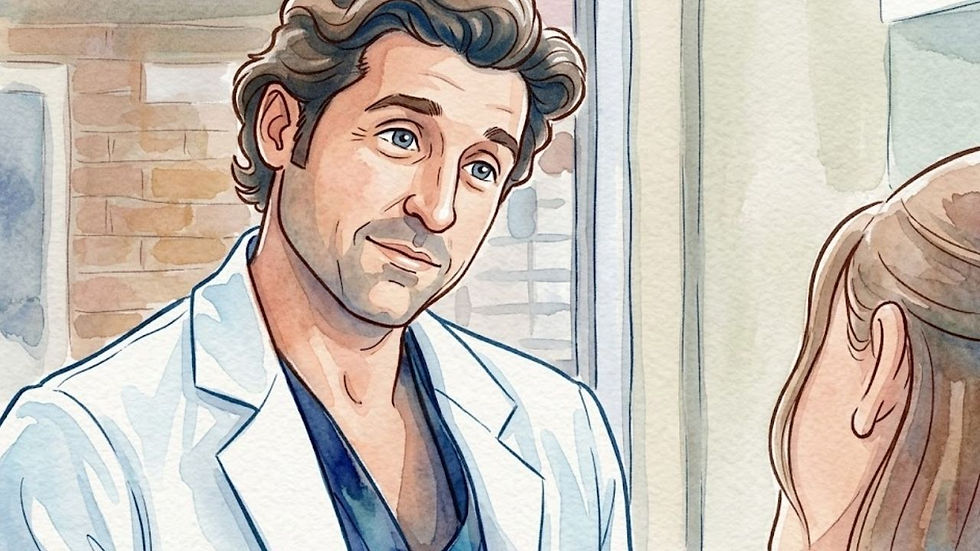
A neurosurgical case where Derek Shepherd performed a clipping procedure.
Care Team
Derek Shepherd and Meredith Grey (scrubbed in).
Treatment
Aneurysm clipping.
What they did right
Dr. Shepherd performed an aneurysm clipping, which is a standard neurosurgical procedure to prevent a ruptured vessel in the brain. He invited an intern to "scrub in," which aligns with the standard teaching hospital model.

End-Stage Heart Failure
(Historical Case)
Diagnosis
End-Stage Heart Failure.
Definition
A chronic, progressive condition where the heart muscle is unable to pump enough blood to meet the body's needs for blood and oxygen. In advanced stages, it requires mechanical support (LVAD) or a heart transplant.
Patient
Denny Duquette.
Case Summary
Although the patient is deceased, his father arrived at the hospital seeking answers about Denny’s final hours and his engagement to Izzie Stevens. A recording revealed Denny’s joy over receiving his "coração semi-novo" (used heart) just before he died.
Care Team
Previously Isabel (Izzie) Stevens.
Treatment
Heart transplant (before the current episode).
What they did wrong
While this case is discussed in the past tense during the episode, it highlights a total breakdown of professional boundaries. Dr. Izzie Stevens became romantically involved with and engaged to her patient. She also famously cut his LVAD wire (the "machine" mentioned) to move him up the transplant list.
What they did right
The use of an LVAD (Left Ventricular Assist Device) as a "bridge to transplant" for a patient with a failing heart is a standard and effective modern medical practice. Outside of the sources: Modern transplant protocols have extremely strict oversight (UNOS) to prevent the type of tampering depicted in the flashback of this case.

🔖 Key Takeaways
🗝️ Cognitive bias delayed a clear appendicitis diagnosis, showing how assumptions (like pregnancy) can compromise timely care.
🗝️ Ignoring interdisciplinary advice in trauma cases (facial burns with hematoma) highlights serious safety risks in surgical decision-making.
🗝️ Fetal distress and failure to descend emphasize the importance of timely intervention over rigid birth plans.
🗝️ Hidden surgical impairment (Burke’s tremor) represents a major ethical violation with life-threatening consequences.
🗝️ Emergency responses like appendectomy, C-section, and aneurysm clipping reflect accurate, life-saving medical practices.
🗝️ The episode reinforces that strong communication, protocol adherence, and ethical boundaries are essential in modern medicine.
Keywords: Grey's Anatomy S3E4
Grey's Anatomy S3E4




Comments