

The Resident TV Series Medical Review: Anti-NMDA Receptor Encephalitis (S2E06 Review)
- Apr 13
- 7 min read
Medical television dramas consistently reach their highest narrative peaks when they explore the terrifying, shadowy borderlands between the mind and the physical body. There is perhaps no medical scenario more deeply unsettling than a patient whose very reality is fracturing, especially when the medical establishment insists the problem is purely psychological. The sixth episode of this acclaimed series’ second season masterfully tackles the harrowing phenomenon of autoimmune-induced psychosis, illustrating the devastating consequences of diagnostic anchoring. When a young woman presents with symptoms that easily mimic a psychiatric break, it takes an elite, fiercely observant medical team to look past the "hysteria" label and hunt for a hidden biological culprit. Without revealing the overarching seasonal plotlines, character relationships, or hospital politics, this review will meticulously dissect the episode's central clinical mystery. We will explore the deceptive presentation of autoimmune encephalitis, the exhaustive differential diagnoses across the hospital, the terrifying reality of rare psychological syndromes, and the aggressive, life-saving interventions deployed at Chastain Park Memorial Hospital.

Initial Presentation and the Emergency Room Visit
The clinical core of this episode is anchored by Laurie Dante, a young woman who arrives at the emergency room in a state of profound distress and utter exhaustion. Her presentation is a tragic testament to the phenomenon of the dismissed patient. Laurie suffers from extreme, unrelenting insomnia, accompanied by what she vaguely describes as intense "episodes" and terrifying, vivid nightmares that bleed into her waking life.
Before arriving at Chastain, Laurie had already been evaluated and summarily dismissed by three previous doctors who found absolutely nothing physically wrong with her. To the untrained eye or a rushed clinician, a young woman presenting with insomnia, anxiety, and nightmares is easily triaged as a psychiatric or stress-related case. However, at Chastain Park Memorial, her escalating agitation and visibly deteriorating mental state signal to the astute medical staff that her symptoms are not merely the result of a generalized anxiety disorder. Her emergency room visit quickly transforms from a routine psychiatric consult into a desperate race against an unseen, rapidly progressing neurological fire.

History of Present Illness and Symptoms
In complex diagnostic medicine, tracking the progression of a patient’s symptoms is the ultimate key to separating organic disease from psychological distress. For Laurie, her history is a terrifying timeline of cognitive decline. What began as simple insomnia quickly escalated into intense nightmares, but the most alarming shift occurs right in front of the medical team.
Laurie’s illness progresses into a highly specific and bizarre neurological manifestation known as Capgras Syndrome. This rare psychological condition is characterized by the absolute, delusional belief that a familiar person has been replaced by an identical imposter. Laurie suddenly becomes convinced that her own treating physician is a malicious imposter, displaying genuine terror. This syndrome is not a simple hallucination; it stems from a distinct physical disconnect in the brain's emotional recognition center. While she can visually recognize the face of her doctor, the neurological wire that attaches a feeling of familiarity to that face has been severed. This sudden, bizarre symptom shifts her history from a narrative of general distress to one of acute, highly localized brain dysfunction.

The Vast Landscape of Differential Diagnoses
When dealing with a patient exhibiting profound hallucinations, paranoia, and insomnia, the medical team is forced to cast a wide diagnostic net, navigating a complex landscape of toxicological, psychiatric, and traumatic differential diagnoses.
Initially, because of the bizarre and paranoid nature of Laurie's behavior, the most glaring suspicion is Schizophrenia, a chronic and severe mental disorder involving deep distortions in thinking and perception. The team investigates this as a potential hereditary cause for her psychotic symptoms. They must also consider whether her episodes are severe manifestations of a Panic Attack, a sudden episode of intense fear or anxiety that triggers physical symptoms like hyperventilation and difficulty breathing. Toxicology must be aggressively ruled out; the physicians consider an Oxycodone Overdose, as ingesting a toxic amount of this opioid can lead to altered mental states, respiratory failure, and death. Furthermore, they must rule out traumatic neurological injuries, such as a Concussion—a form of traumatic brain injury resulting from an impact to the head that requires clinical observation for several hours to monitor for subtle, evolving neurological changes.
While the diagnostic mystery surrounding Laurie deepens, the bustling Chastain emergency department manages a barrage of other catastrophic, unrelated physical traumas that highlight the intense pressure of the hospital environment. The trauma bay works frantically to resuscitate a patient suffering from Cardiac Tamponade, a medical emergency where fluid or blood rapidly builds up in the space around the heart, creating immense pressure that prevents the heart from pumping effectively. Simultaneously, surgical teams are pulled away to address a Pulmonary Artery Laceration, a severe, highly lethal injury involving a tear in the main artery carrying deoxygenated blood to the lungs, leading to rapid internal bleeding and cardiovascular collapse.

The Definitive Diagnoses: Clinical Clues and Confirmations

The brilliant diagnostic breakthrough in Laurie’s case relies on a remarkably simple, low-tech neurological exam: the clock-drawing test. When asked to draw the face of a clock, Laurie confidently draws the circle but places all the numbers (1 through 12) crammed onto only one side of the clock face. This specific failure is a classic sign of hemispatial neglect, proving definitively that her symptoms have a profound biological, neurological basis rather than a primary psychiatric one like schizophrenia.
However, before the team can pinpoint the exact disease, Laurie suffers a violent psychotic break. In her terrified, delusional state, she accidentally severs her own femoral artery, resulting in massive, spurting blood loss. This plunges her into Hemorrhagic Shock, a life-threatening state resulting from rapid and significant blood loss that prevents the heart from pumping enough blood to maintain adequate oxygen levels in the body.
She is rushed into emergency surgery to repair the artery. While her abdomen is exposed on the operating table, Dr. Conrad Hawkins instructs the surgical team to investigate a seemingly unrelated "incidentaloma"—a medical term for an asymptomatic, typically benign growth discovered by chance during a diagnostic imaging scan. When the surgeons resect this incidental mass from her ovary, they make a horrifying discovery: it is a Teratoma, a rare genetic germ cell tumor that, astonishingly, contains a fully formed human tooth. This bizarre finding is the final puzzle piece, leading to the definitive diagnosis of Anti-NMDA Receptor Encephalitis.
Etymology of the Diagnoses
The diagnosis is a descriptive mouthful. "Anti" indicates an autoimmune response (against). "NMDA" stands for N-methyl-D-aspartate, a specific type of critical receptor in the brain involved in memory and behavior. "Encephalitis" combines the Greek "enkephalos" (brain) and the suffix "-itis" (inflammation). "Teratoma" is derived from the Greek word "teras," meaning monster, and the suffix "-oma," meaning tumor, historically referring to the monstrous appearance of tumors containing hair, teeth, or bone. "Capgras" is named after Jean Marie Joseph Capgras, the French psychiatrist who first described the illusion of doubles in 1923.
Pathophysiology
The pathophysiology of Laurie's condition is an incredible, terrifying cascade of biological friendly fire. It began with the teratoma in her ovary. Because germ cell tumors can differentiate into any tissue type, Laurie's teratoma developed neural tissue (brain cells) alongside the tooth. Her immune system correctly identified the teratoma as a foreign tumor and generated antibodies to destroy it. Tragically, because the tumor contained brain tissue, these highly specific antibodies crossed the blood-brain barrier and began aggressively attacking the NMDA receptors in Laurie's actual brain. By neutralizing these receptors, the antibodies triggered massive brain inflammation (encephalitis) and completely disrupted her cognitive, emotional, and autonomic functions, leading to her insomnia, Capgras syndrome, and violent psychosis.
Real-World Epidemiology
Anti-NMDA Receptor Encephalitis is a relatively newly recognized disease, first identified in 2007. It gained mainstream public awareness through the bestselling memoir Brain on Fire by Susannah Cahalan. Epidemiologically, it disproportionately affects young women, and in roughly half of all cases, it is directly associated with the presence of an underlying ovarian teratoma. Because its initial symptoms so perfectly mimic acute schizophrenia or a manic episode, it is notoriously misdiagnosed by psychiatric professionals, leading to dangerous delays in life-saving medical treatment.

Aggressive Treatments and Medical Interventions
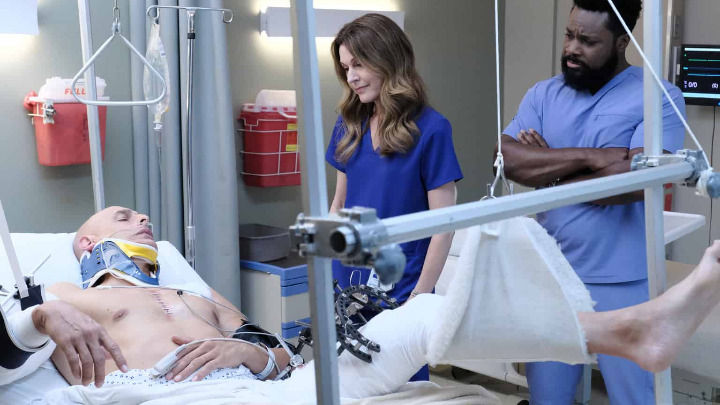
Treating a patient with Anti-NMDA Receptor Encephalitis complicated by hemorrhagic shock requires aggressive, multi-disciplinary intervention.
The immediate life threat is mechanical: the surgical team must meticulously repair the severed femoral artery to halt the massive blood loss, accompanied by rapid blood transfusions and fluid resuscitation to reverse the profound hemorrhagic shock and stabilize her cardiovascular system. During this same operation, the surgical removal of the ovarian teratoma (the "incidentaloma") is performed. Resecting the tumor is the most critical step in curing the disease, as it physically removes the source that is triggering the immune system's antibody production.
With the tumor gone, the internal medicine team shifts to aggressive pharmacological therapy to address the antibodies already ravaging her brain. Laurie is treated with a potent combination of high-dose intravenous steroids and immunoglobulins (IVIG). The steroids massively suppress systemic inflammation, while the intravenous immunoglobulins bind to and neutralize the rogue antibodies attacking her NMDA receptors. With the source removed and the immune system suppressed, the prognosis is highly optimistic; Laurie is expected to make a full neurological recovery and return to her normal life once the autoimmune storm fully subsides.

A Curious Clinical Fact: Tumors with Teeth
One of the most visually shocking elements of Laurie's case is the discovery of a tooth inside her tumor. While it sounds like science fiction, this is a well-documented reality of Teratomas. A teratoma is a type of germ cell tumor. Germ cells are the pluripotent stem cells in the body (found in the ovaries and testes) that have the unique biological potential to grow into literally any type of human tissue. When these cells mutate and form a tumor, they retain this chaotic developmental potential. Therefore, it is entirely common for pathologists to open a surgically removed teratoma and find highly differentiated, disorganized tissues, including fully formed hair follicles, clumps of muscle, thyroid tissue, bone fragments, and perfectly enameled teeth growing inside the mass!

🔖 Key Takeaways
🗝️ Psychiatric symptoms often have biological roots: Acute, sudden-onset psychosis, insomnia, and hallucinations in a previously healthy young woman should always prompt an investigation for autoimmune encephalitis before defaulting to a schizophrenia diagnosis.
🗝️ The clock-drawing test is a powerful diagnostic tool: This simple bedside test can instantly differentiate a primary psychiatric break from a structural neurological deficit (like hemispatial neglect) caused by brain inflammation.
🗝️ Capgras Syndrome is a disconnect in emotional recognition: The terrifying delusion that loved ones or doctors have been replaced by imposters is caused by a physical disruption in the brain's facial-emotional processing pathways.
🗝️ Teratomas trigger friendly fire: Ovarian germ cell tumors containing neural tissue can trick the immune system into creating antibodies that cross the blood-brain barrier and attack the central nervous system.
🗝️ Incidentalomas must not be ignored: A seemingly harmless, asymptomatic growth discovered by accident on a scan can be the hidden catalyst for a massive systemic or neurological crisis.
🗝️ Treatment requires removing the source: Curing Anti-NMDA Receptor Encephalitis relies heavily on surgically excising the underlying teratoma, followed by aggressive immunosuppression with steroids and IVIG to halt the brain damage.
Keywords: The Resident Medical Review S2E06
The Resident Medical Review S2E06



Comments