

The Resident TV Series Medical Review: Avascular Necrosis, Migrating Foreign Body (S4E07 Review)
- 5 days ago
- 9 min read

Medical dramas are at their most compelling when they explore how the human body keeps the score, harboring the physical echoes of our pasts for years or even decades. Season 4, Episode 7 of The Resident delivers a masterclass in this concept, bringing past traumas violently into the present. The episode challenges the Chastain Park Memorial medical team with two incredibly unique clinical presentations: a chronic illness warrior facing the progressive destruction of her own skeleton, and a combat veteran whose life is threatened by a literal piece of his history moving through his bloodstream. By weaving together the complex hematological reality of sickle cell disease with a bizarre, one-in-a-million surgical emergency, this episode highlights the relentless diagnostic vigilance required to practice medicine at its highest level. In this comprehensive review, we will dissect the agonizing clinical presentations, untangle the chaotic web of differential diagnoses, and explore the underlying pathologies that defined this unforgettable hour of television.

Initial Presentation and Emergency Room Visits
The threshold of an emergency department serves as a stark dividing line between the controlled reality of everyday life and the chaotic battle for survival. In this episode, the Chastain staff is confronted with two drastically different presentations that both demand immediate, high-acuity intervention.
The primary medical investigation centers on Rose Williams, a vibrant dancer and teacher living with sickle cell disease. Rose’s presentation to the hospital is marked by agonizing, debilitating pain. While sickle cell patients are tragically accustomed to the severe discomfort of vaso-occlusive crises, Rose describes this specific pain as feeling like "shards of glass in my veins." Furthermore, unlike her typical sickle cell flares, this excruciating pain is localized entirely to her hip, is completely constant, and is severely exacerbated by even the slightest movement. Her presentation indicates that a profound structural failure is occurring deep within her joint, robbing her of her mobility and threatening her career.
Simultaneously, the trauma bays are rocked by the arrival of Captain Nate Hill, Dr. Conrad Hawkins’ former commanding officer. Nate is airlifted to Chastain following a catastrophic free-climbing accident. His initial presentation is the quintessential trauma nightmare: he arrives with a massive, deep abdominal gash and undeniable signs of severe internal bleeding. As the trauma team swarms his stretcher, they are immediately confronted with a cascade of physiological alarms. Nate exhibits Hypotension, Tachycardia, and Hypoxia—abnormally low blood pressure, an excessively rapid heart rate, and insufficient oxygen levels in his tissues, a deadly triad that collectively indicates acute and rapidly deteriorating patient instability.

The History of Presenting Symptoms
A patient’s medical history is the vital context that frames every diagnostic decision. For both Rose and Nate, their historical backgrounds dictated the severity of their crises and the extraordinary complexities of their treatments.
For Rose Williams, her medical history is defined by a lifelong battle with sickle cell disease. Her history is a documented saga of countless hospitalizations and numerous blood transfusions required to manage her chronic anemia and pain crises. However, the history of her presenting hip symptom is uniquely insidious. The pain did not occur following a sudden injury or fall; rather, it developed progressively, a silent, ischemic destruction occurring over months or years. Furthermore, her extensive history of receiving donor blood meant her immune system had been exposed to a vast array of foreign red blood cell antigens, a historical detail that would soon trigger a life-threatening postoperative nightmare.
Captain Nate Hill’s history is steeped in the violence of combat. His history of presenting symptoms involves not just the acute trauma of his rock-climbing fall, but a lingering, physical scar from his time in Afghanistan. Ten years prior, while saving Conrad’s life, Nate was shot. The bullet could not be safely removed at the time, leaving Nate to carry the projectile lodged safely near his spine for a decade. This metallic "constant companion" was a known entity in his medical history, completely asymptomatic for years—until the severe mechanical force of his climbing accident suddenly altered its trajectory.

Navigating the Differential Diagnoses
In the chaotic aftermath of a severe trauma and the agonizing depths of a chronic pain crisis, physicians must meticulously rule out a multitude of cascading complications while managing a hospital bursting at the seams with other emergencies.
When evaluating Captain Hill’s massive trauma, the differential diagnosis list was extensive. The team had to quickly rule out a Hemothorax, a dangerous collection of blood within the pleural cavity that can occur due to blunt or penetrating trauma. They investigated him for Broken Ribs, Dislocated Shoulders, and a Broken Knee, all standard injuries sustained during high-impact falls. The team also had to ensure his abdominal gash had not caused a Diaphragmatic Rupture, a severe tear in the muscle separating the chest and abdomen that allows internal bleeding to spill into both cavities. Given his military past, they even considered whether the fall had dislodged old Shrapnel Injuries.
While managing Nate and Rose, the broader hospital operated as a frantic differential battleground. Surgeons evaluated a patient for a highly complex Quadruple Heart Valve Disease, a rare condition involving dysfunction of the aortic, pulmonary, tricuspid, and mitral valves requiring total replacement. Trauma teams rushed to repair an Aortic Rupture, a critical tear in the body's largest artery, while neurologists assessed patients for devastating Medial and Lateral Cord Nerve Injuries, involving the complete severance of the brachial plexus resulting in total loss of hand function. The staff even had to manage terrifying procedural complications, such as an Iatrogenic Vena Cava Puncture, where a central line accidentally pierced the major vein, causing severe internal hemorrhaging.
For Rose, the differential diagnosis initially leaned toward a standard sickle cell crisis or an acute joint infection (septic arthritis). However, when evaluating her hip pain, Dr. Devon Pravesh recognized that her symptoms were structural, not just inflammatory, prompting targeted radiological imaging to rule out a fracture or a dying bone.
The most terrifying differential shift occurred with Nate. During his trauma evaluation, Conrad noticed that the 10-year-old bullet was missing from Nate's spinal X-rays. Moments later, Nate developed sudden Respiratory Distress—a life-threatening state where the lungs fail to provide sufficient oxygen, leading to choking—followed immediately by stroke symptoms, including facial numbness and light-headedness. The team had to rapidly differentiate whether he was suffering from a traumatic brain injury, a fat embolism from his fall, or an embolic stroke caused by a migrating foreign body.

The Definitive Diagnoses and Clinical Clues
The resolutions to both medical crises relied on unparalleled clinical observation and the willingness to pursue advanced radiological testing to uncover the true nature of the pathologies.
For Rose Williams, the definitive diagnosis was Avascular Necrosis of the hip. The clinical clue was provided by a targeted X-ray, which revealed the characteristic crumbling and death of the femoral head. Following her successful hip replacement surgery, Rose developed a secondary, life-threatening diagnosis: a Delayed Hemolytic Transfusion Reaction. The clinical clues were a sudden drop in hemoglobin, jaundice, and unstable tachycardia. Because of the many blood transfusions she had received throughout her life, she had developed rare alloantibodies. Her immune system recognized the newly transfused surgical blood as a foreign invader and aggressively attacked it, causing severe anemia.
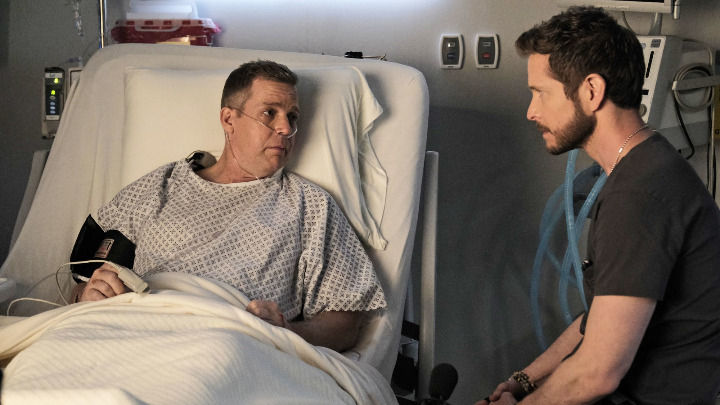
For Captain Nate Hill, the definitive diagnosis was an Embolic Stroke secondary to a Migrating Foreign Body (Bullet). The initial clinical clue was the missing bullet on his chest and spine X-rays. When Nate exhibited stroke symptoms, a CT scan of his head and neck was ordered. Though the scan was partially distorted by "streak artifacts" caused by his Dental Cavities (a common radiological phenomenon where dense metallic fillings scatter the X-ray beams), the imaging clearly revealed the bullet fragment had migrated and lodged directly in the carotid bifurcation. The bullet was physically blocking the blood supply to his brain, causing "mini-strokes" (TIAs) and threatening a massive, permanent infarction.
Etymology of the Diagnoses
"Avascular" combines the prefix a- (meaning "without") and vascular (relating to blood vessels). "Necrosis" comes from the Greek nekrosis, meaning "death." Therefore, Avascular Necrosis literally translates to tissue death due to a lack of blood supply. "Hemolytic" originates from hemo- (blood) and lysis (destruction or breaking down). "Embolic" refers to an embolus, derived from the Greek embolos (peg or stopper), denoting a detached mass traveling through the bloodstream until it creates a blockage.
Brief Pathophysiology
Avascular Necrosis in sickle cell disease is a devastating mechanical failure. Sickle cell anemia causes red blood cells to become rigid and crescent-shaped. Over time, these malformed cells clump together and block the tiny microvasculature (capillaries) that supply blood to the bones. Without a steady supply of oxygen and nutrients, the bone tissue in the hip (the femoral head) slowly starves and dies. As the bone necroses, it loses its structural integrity, eventually collapsing under the weight of the body and causing agonizing, "shards of glass" pain.
The pathophysiology of Nate's migrating bullet is exceptionally rare but purely mechanical. Over ten years, the bullet rested near his spine. However, the extreme blunt force trauma of his free-climbing fall caused the projectile to erode through the surrounding scar tissue and penetrate the wall of a nearby major vein. Once inside the vascular system, the bullet was swept away by the venous blood return, traveling through the right side of the heart, passing through a potential structural defect (like a Patent Foramen Ovale) into the arterial system, and ultimately being pumped up into the carotid artery where it wedged at the bifurcation, choking off the brain's oxygen supply.
Real-World Epidemiology
Avascular Necrosis is a distressingly common complication for adults living with sickle cell disease, affecting up to 50% of patients by the time they reach age 35, frequently necessitating total joint replacements. Delayed hemolytic transfusion reactions are a well-documented and severe risk for patients requiring chronic transfusions, underscoring the critical need for extensive, highly specific blood typing beyond just the ABO and Rh systems. Conversely, the intravascular migration of a retained bullet is a profound clinical rarity. While foreign body embolization is documented in medical literature (often involving broken catheter tips or small shrapnel), a large caliber bullet surviving a ten-year dormancy before migrating to the carotid artery is an extraordinary, once-in-a-career presentation.

Specialized Treatments Administered

The medical management in this episode showcased the brilliance of orthopedic reconstruction, advanced hematology, and high-stakes vascular surgery.
To restore Rose's mobility, the surgical team performed a complex Total Hip Arthroplasty (Hip Replacement), utilizing advanced "ceramic on polyethylene" prosthetics designed for high durability and smooth articulation. However, when she developed the delayed hemolytic transfusion reaction, her treatment shifted to intense metabolic rescue. As her heart went into unstable tachycardia due to the profound anemia, the team had to immediately cardiovert her heart—delivering a synchronized electrical shock to the chest to reset her heart rhythm to normal. Simultaneously, the hospital's blood bank worked frantically with the Red Cross to source a rare, "closest-match" unit of blood that lacked the specific antigens Rose's immune system was attacking. This highly specialized blood transfusion successfully stabilized her hemoglobin and saved her life.
Captain Nate Hill’s treatment required an incredibly delicate and urgent vascular intervention. Dr. AJ Austin performed an emergency Carotid Endarterectomy-style surgery to remove the migrating bullet. Making an incision in Nate's neck, Dr. Austin clamped the carotid artery to prevent the bullet from dislodging further into the brain, opened the blood vessel, and physically extracted the metallic fragment. Removing the "constant companion" instantly restored cerebral blood flow, eliminating the stroke symptoms and finally relieving both Nate and Conrad of the emotional weight the bullet had represented for a decade.

A Curious Medical Fact: The Artifact of Dental Cavities
One of the most fascinating radiological hurdles featured in Nate's diagnosis is the interference caused by dental work. When a patient undergoes a CT scan of the head or neck, the presence of dental fillings, implants, or crowns (often used to treat cavities) can severely degrade the image quality. This occurs because the metals used in dentistry (such as amalgam or titanium) are incredibly dense. When the X-ray beams of the CT scanner hit these dense materials, the photons are entirely absorbed or scattered, creating what radiologists call "streak artifacts." These artifacts appear as bright, starburst-like lines that shoot across the resulting image, frequently obscuring vital anatomical structures like the carotid arteries or the base of the brain. Radiologists must often use specialized software algorithms to digitally subtract these metallic artifacts to clearly visualize life-threatening pathologies like a migrating bullet.

🔖 Key Takeaways
🗝️ Avascular Necrosis is a severe, structural complication of sickle cell disease caused by sickled cells blocking blood flow to the bone, leading to tissue death and joint collapse.
🗝️ Delayed Hemolytic Transfusion Reactions are life-threatening immune responses occurring when a patient with a history of multiple transfusions develops alloantibodies that aggressively attack newly transfused, mismatched donor blood.
🗝️ Cardioversion is a critical emergency procedure used to deliver a synchronized electrical shock to the heart, resetting unstable, rapid arrhythmias (tachycardia) caused by severe physiological stress.
🗝️ Foreign body embolization (a migrating bullet) is an exceedingly rare phenomenon where a retained projectile erodes into the vascular system and travels with the blood flow, potentially causing catastrophic blockages like an embolic stroke.
🗝️ Dental artifacts can severely obscure CT scan imaging of the head and neck, as dense metallic fillings cause X-ray beams to scatter, creating bright streaks that hide underlying vascular structures.
🗝️ Chronic illness and past combat injuries require intense, ongoing medical vigilance, as the human body can harbor silent, dormant pathologies that suddenly erupt into acute, life-threatening emergencies years later.
Keywords: The Resident Medical Review S4E07
The Resident Medical Review S4E07


Comments