

The Resident TV Series Medical Review: Inflammatory Myofibroblastic Tumor (S4E11 Review)
- 4 days ago
- 8 min read

Medical dramas continually captivate audiences by pushing the boundaries of what seems scientifically and surgically possible, often blurring the line between science fiction and modern medical reality. Season 4, Episode 11 of The Resident is a masterclass in this exact phenomenon, delivering an emotionally charged and anatomically staggering narrative. Within the high-pressure walls of Chastain Park Memorial Hospital, the surgical team is confronted with a pediatric case so severe that it had already been deemed terminal by other medical professionals. This episode strips away the standard protocols of routine surgery and plunges viewers into the desperate, high-stakes world of extreme surgical oncology. By chronicling the harrowing journey of a young girl with a massive, organ-strangling tumor, the show highlights the relentless innovation and sheer audacity required to snatch a life back from the brink. In this comprehensive review, we will dissect the agonizing clinical presentations, untangle the chaotic web of differential diagnoses, and explore the underlying pathology of a rare tumor that forced surgeons to perform a medical miracle, all while preserving the poignant emotional core of the series.

Initial Presentation and Emergency Room Visits
The threshold of an emergency department serves as a stark dividing line between the routine occurrences of daily life and the onset of a life-altering crisis. In this episode, the Chastain staff is confronted with a multitude of drastically different presentations that demand immediate, high-acuity intervention.
The primary medical investigation centers on Sammie, a vibrant seven-year-old girl recently adopted from China. Sammie’s presentation to the hospital is marked by agonizing and debilitating distress. She arrives at Chastain suffering from severe abdominal pain, persistent nausea, and violent episodes of vomiting. However, the most alarming hallmark of her presentation is her persistent, uncontrollable nosebleeds. In a pediatric patient, severe abdominal pain coupled with spontaneous bleeding is a massive clinical red flag, indicating that a localized gastrointestinal issue has escalated into a profound, systemic physiological collapse.
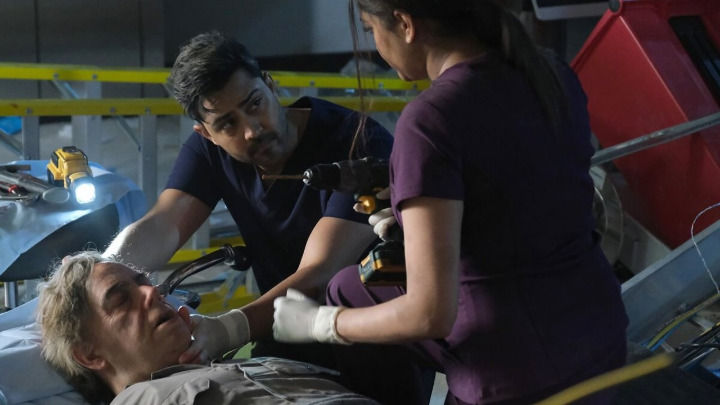
Simultaneously, the trauma bays are rocked by a chaotic influx of high-velocity emergencies. The ER staff must manage a patient with a gruesome Penetrating Head Trauma—a critical injury involving a metal rod piercing the skull and entering the brain tissue. Right beside this case, the team battles to stabilize an Open Spinal Injury, a severe traumatic condition where the cervical spine is exposed to the external environment, carrying an incredibly high risk of permanent neurological damage and infection. The ER is further overwhelmed by patients presenting with Hemorrhagic Shock (a life-threatening state of decreased tissue perfusion resulting from rapid blood loss) and complex Fractures requiring immediate stabilization. This intense, bloody background noise provides a stark contrast to Sammie's quiet, insidious internal failure.

The History of Presenting Symptoms
A patient’s medical history is the vital context that frames every diagnostic decision. For Sammie, her historical background dictated the severity of her crisis and the extraordinary complexities of her required treatment.
Sammie’s history of presenting symptoms was deeply intertwined with her recent adoption. Because she was recently adopted from China, her early medical history may have been fragmented, allowing a silent pathology to grow unchecked. By the time her adoptive parents sought help, they had already been delivered a devastating historical label: they were told her condition was terminal. The tumor had not appeared overnight; its history was one of slow, aggressive local invasion, eventually wrapping itself around her pancreas, stomach, liver, spleen, and intestines. As the mass grew, it silently choked off her internal anatomy until the symptoms of organ failure became too severe to ignore.
The hospital was also buzzing with the chronic and historical management of other severe conditions. Physicians evaluated the historical records of patients battling Lung Cancer, preparing them for intensive oncology care. The hematology department was deeply involved in the history of a patient with Sickle Cell Disease, managing the severe anemia and preparing for grueling myeloablative chemotherapy prior to a cutting-edge gene therapy trial. The staff even factored in neurocognitive histories, noting conditions like Dyslexia—a neurodevelopmental learning disorder characterized by difficulties with accurate word recognition—to ensure comprehensive, holistic patient care.

Navigating the Differential Diagnoses
In the chaotic aftermath of a severe trauma admission and the confusing presentation of generalized abdominal symptoms, physicians must meticulously rule out a multitude of cascading complications while managing a hospital bursting at the seams with other emergencies.
When evaluating Sammie’s severe abdominal pain and vomiting, the differential diagnosis list for a pediatric patient is extensive. The team initially had to consider common ailments like severe appendicitis or a bowel obstruction. However, her persistent nosebleeds completely shifted the differential paradigm. Spontaneous mucosal bleeding indicates a severe drop in clotting factors, pointing a glaring spotlight directly at the liver, the body's primary factory for coagulation proteins. The team had to quickly differentiate between acute viral hepatitis, a primary liver malignancy (like hepatoblastoma), or a massive structural blockage causing secondary liver failure.
While managing Sammie's evolving case, the broader hospital operated as a frantic differential battleground. Neurosurgeons rushed to the trauma bay to manage a patient suffering from a Grand Mal Seizure—a generalized tonic-clonic seizure involving a loss of consciousness and violent muscle contractions. They had to rapidly determine if the seizure was secondary to acute brain trauma, eventually diagnosing an Epidural Hematoma: a traumatic accumulation of blood between the skull and the dura mater resulting from a lacerated middle meningeal artery. Cardiology teams were equally strained, treating patients flipping into Ventricular Tachycardia (V-tach), a fast, abnormal heart rhythm originating in the ventricles that can lead to immediate cardiac arrest if not shocked back into a normal rhythm.
Through advanced radiological imaging, the Chastain team finally pierced through the differential fog surrounding Sammie, revealing an abdominal landscape so heavily entangled in diseased tissue that it defied standard surgical intervention.

The Definitive Diagnoses and Clinical Clues
The resolution to Sammie's terrifying medical mystery relied on advanced imaging and the refusal to accept a terminal prognosis without exploring every conceivable physiological pathway.
The definitive diagnosis for Sammie was a massive Inflammatory Myofibroblastic Tumor (IMT). The imaging provided the undeniable clinical clues: the massive tumor had completely engulfed her upper abdominal organs. The critical breakthrough explaining her liver failure and nosebleeds was the discovery that the tumor had completely occluded the spleno-mesenteric junction. By crushing this vital intersection of blood vessels, the tumor cut off the necessary blood flow to and from the liver. Without adequate blood supply, the liver began to fail, halting the production of essential clotting factors, which directly resulted in her dangerous, uncontrollable nosebleeds.
Etymology of the Diagnosis
The name "Inflammatory Myofibroblastic Tumor" is a highly descriptive pathological term. "Inflammatory" refers to the heavy presence of inflammatory immune cells (like plasma cells and lymphocytes) found within the tumor matrix. "Myofibroblastic" combines "myo-" (muscle) and "fibroblast" (the cells that synthesize the extracellular matrix and collagen). Therefore, an IMT is a mass composed of spindle-shaped connective tissue cells that exhibit features of both fibroblasts and smooth muscle cells, heavily infiltrated by inflammatory cells.
Brief Pathophysiology
Inflammatory myofibroblastic tumors are rare mesenchymal neoplasms. Unlike many aggressive cancers that metastasize (spread) through the bloodstream to distant organs, IMTs are typically characterized by their aggressive local behavior. They originate in connective tissue and grow relentlessly outward, invading and encasing any surrounding structures. In Sammie’s case, the tumor acted like a parasitic vine, wrapping itself tightly around her pancreas, stomach, liver, spleen, and intestines. The sheer physical compression caused by the mass obstructed the spleno-mesenteric junction, leading to a backup of venous blood, severe portal hypertension, and the subsequent mechanical failure of her liver and coagulation cascades.
Real-World Epidemiology
Inflammatory myofibroblastic tumors are exceptionally rare, with an exact incidence rate that is difficult to pinpoint but is recognized as representing a tiny fraction of all soft tissue tumors. They most commonly occur in children and young adults. While they can arise anywhere in the body, the lungs, abdomen, and pelvis are the most frequent sites. Because they are so rare and their clinical presentation depends entirely on which organs they are compressing, they frequently mimic other malignant tumors or severe infections, making accurate diagnosis a significant challenge requiring specialized biopsy and histological analysis.

Specialized Treatments Administered

The medical management of Sammie’s case required a heartbreaking pivot from standard surgical resections to an incredibly rare, "Hail Mary" procedure that tested the absolute limits of the Chastain surgical team.
Because the tumor was hopelessly entangled in the blood vessels supplying her vital organs, attempting to cut the tumor out while the organs were still inside Sammie would result in fatal bleeding. To save her life, Drs. Bell, Austin, and Jake Wong performed a miraculous Auto-Transplantation (Ex Vivo Surgery).
This procedure required the surgical team to perform an en bloc resection—meaning they completely removed all of her abdominal organs (liver, pancreas, spleen, stomach, and intestines) from her body at once. With Sammie's empty abdominal cavity temporarily stabilized, the surgeons moved the organs to a "back table." Operating on the organs while they were outside the body and preserved on ice, the team meticulously dissected the tumor away from the healthy tissue in a bloodless field.
During this grueling process, the team discovered a secondary complication: an undetected Malignant Growth in the Abdominal Wall, which threatened their ability to successfully close the surgical site. Ultimately, the tumors were too deeply integrated into certain organs; the team was forced to permanently remove her pancreas, spleen, and stomach. However, the surgeons successfully re-implanted her healthy liver and intestines, meticulously reconnecting the tiny blood vessels to restore blood flow. While the surgery successfully eradicated the tumor and saved her life, the loss of her pancreas and stomach means Sammie faces a lifelong recovery involving severe dietary changes, insulin-dependent diabetes, and the potential for future restorative operations.

A Curious Medical Fact: The "Back Table" Miracle
One of the most fascinating aspects of Sammie's surgery is the concept of ex vivo surgery, commonly referred to as "back table" surgery. When a tumor is intimately wrapped around the complex, delicate blood vessels of an organ, operating inside the warm, blood-filled cavity of a living patient is often impossible due to the risk of uncontrollable hemorrhage. Ex vivo surgery solves this by treating the patient's own organs as if they were donor organs. The organs are completely severed, removed, and immediately flushed with a cold preservation solution. Placed in a basin of slushy ice on a separate surgical table, the organ's metabolic rate drops to almost zero, buying the surgeons precious hours to carefully dissect the tumor in a completely bloodless, highly visible environment. Once the organ is repaired and tumor-free, it is auto-transplanted back into the patient. It is a stunning display of surgical ingenuity that literally requires a patient to survive without their organs for hours at a time.

🔖 Key Takeaways
🗝️ Inflammatory Myofibroblastic Tumors (IMTs) are rare soft tissue masses that grow aggressively in local areas, frequently encasing and strangling surrounding vital organs and blood vessels.
🗝️ Spontaneous nosebleeds and mucosal bleeding in the presence of an abdominal mass are severe clinical warning signs of liver failure and a dangerous depletion of the body's clotting factors.
🗝️ Occlusion of the spleno-mesenteric junction causes a severe backup of blood flow, directly leading to the mechanical failure of the liver and subsequent coagulopathy.
🗝️ Auto-transplantation (Ex Vivo Surgery) is a rare, extreme surgical intervention where organs are completely removed from the body, operated on over a cold "back table," and then re-implanted into the patient.
🗝️ En bloc resection involves removing multiple organs and tissues together as a single mass to ensure the complete removal of a deeply entangled tumor.
🗝️ The loss of the pancreas, stomach, and spleen requires lifelong medical management, including insulin therapy for induced diabetes and severe dietary modifications to accommodate a reconstructed digestive tract.
Keywords: The Resident Medical Review S4E11
The Resident Medical Review S4E11


Comments