

The Resident TV Series Medical Review: Metastasized Colon Cancer (S6E02 Review)
- 5 hours ago
- 9 min read

Medical dramas frequently build their narrative suspense on the chaotic, high-velocity interventions required in the trauma bay, but the most devastating clinical moments often occur when the noise of acute injury fades to reveal a silent, pre-existing killer. Season 6, Episode 2 of The Resident masterfully executes this narrative bait-and-switch. When a patient is rushed to Chastain Park Memorial Hospital following a violent public brawl, the medical team prepares for standard blunt force trauma management. However, what begins as a routine trauma evaluation quickly devolves into a heartbreaking oncological discovery. By contrasting the visible, chaotic violence of a physical altercation with the invisible, insidious spread of metastatic cancer, this episode highlights a terrifying reality of emergency medicine: trauma is sometimes merely the violent catalyst that unearths a terminal disease. In this comprehensive review, we will dissect this gripping clinical presentation, unravel the complex web of differential diagnoses, and explore the tragic physiological mechanics that defined this unforgettable, high-stakes hour of television.

Initial Presentation and Emergency Room Visits
The threshold of an emergency department serves as a highly pressurized triage zone where medical professionals must instantly distinguish between superficial injuries and impending physiological collapse. In this episode, the Chastain staff is confronted with a massive influx of patients, demanding rapid transitions between various modes of clinical thinking.
The central medical investigation involves Enrique Mendez, a 46-year-old male who is admitted to the ER under highly chaotic circumstances. He was brought in after being violently tackled during a massive brawl that erupted at a local polling station. Enrique’s initial presentation is heavily dominated by the acute trauma he sustained in the fight. He presents with severe, localized chest pain, shortness of breath, and acute abdominal pain. Upon an initial physical exam and subsequent trauma imaging, the emergency team quickly identifies a Fractured Rib—a crack in the bones of the rib cage caused by the physical impact of the tackle. This broken rib had punctured the pleural space, leading to a Collapsed Lung (Pneumothorax), a condition where air leaks into the space between the lung and the chest wall, forcing the delicate lung tissue to collapse and severely compromising his breathing.
While the trauma surgeons prioritize stabilizing Enrique’s airway and breathing, the broader Chastain ER hums with the violent, high-speed reality of the polling station fallout and the daily influx of acute disease. The trauma bays are overflowing with victims of Blunt Trauma from the fight. Physicians are actively managing patients with severe Concussions, evaluating traumatic brain injuries resulting from blows to the head. The facial trauma team treats patients with Periorbital Hematomas (severe black eyes resulting from bleeding into the tissues) and complex Orbital Fractures, where broken bones surrounding the eye socket risk entrapping delicate ocular muscles. Other patients from the brawl are treated for Skull Fractures and Sprained Wrists resulting from defensive posturing. The chaos is further exacerbated by environmental and psychiatric emergencies, including voters suffering from Heat Stroke after standing in the relentless sun, and others experiencing sudden Asthma Attacks triggered by the stress and physical exertion. In a bizarre twist, the medical team deduces that the severe aggression and mood swings that sparked the brawl were actually a rare psychiatric manifestation of Varenicline Side Effects, an anti-smoking medication taken by one of the instigators.

The History of Presenting Symptoms
Gathering a meticulous medical and personal history is the ultimate investigative tool in medicine. For Enrique Mendez, his medical history demonstrates the profound danger of cognitive bias—how patients often normalize chronic pain and mistakenly attribute new, deadly red flags to old, benign conditions.
Despite suffering a violent tackle, Enrique’s most pressing complaint in the ER is acute abdominal pain. However, when questioned by the medical staff, he is quick to dismiss the severity of this symptom. He attributes the cramping, bloating, and intense discomfort to a simple flare-up of his Irritable Bowel Syndrome (IBS), a common, functional disorder affecting the large intestine that he has managed for years. This historical detail is a classic clinical trap. Patients with chronic gastrointestinal issues frequently ignore significant changes in their bowel habits or escalating pain, assuming it is just a worsening of their baseline disease. Enrique’s history of IBS effectively masked the insidious growth of a malignant tumor, allowing the cancer to progress entirely unchecked until the trauma of the brawl inadvertently forced him into an imaging scanner.
Beyond Enrique's case, the episode paints a vivid picture of complex patient histories across the hospital. The staff manages the long-term history of a patient with Multiple Sclerosis (MS), discussing the use of anti-CD20 antibodies to manage the chronic central nervous system disease. They also navigate the fragile history of a patient with severe Osteoporosis, where weak, brittle bones led to a painful T11 Vertebral Fracture from a minor movement. In the intensive care units, physicians deal with the complex histories of patients facing Cardiac Arrest, Atrial Fibrillation with Rapid Ventricular Response (Afib with RVR), and progressive Heart Failure potentially worsened by long-term steroid treatments. The pediatric and psychiatric teams compassionately handle the heartbreaking history of an infant born with Edward's Syndrome (Trisomy 18), a severe genetic condition causing significant developmental delays, while also addressing the chronic, destructive history of a patient battling Drug Addiction involving prescription medications.

Navigating the Differential Diagnoses
In a bustling trauma bay, evaluating a patient who has suffered significant blunt force trauma while complaining of severe abdominal pain requires rigorous, systematic elimination. The trauma itself acts as a massive confounding variable.
For Enrique Mendez, the differential diagnosis for his acute abdominal pain initially focused entirely on traumatic internal injuries. The team had to assume that the tackle that broke his rib and collapsed his lung might have also ruptured his spleen (causing massive internal bleeding) or lacerated his liver. However, a focused assessment with sonography for trauma (FAST exam) and subsequent CT scans ruled out acute hemorrhagic shock from a ruptured organ.
With acute traumatic bleeding ruled out, the differential shifted to his gastrointestinal tract. Enrique insisted it was his IBS, but the imaging told a far more sinister story. The scans revealed a distinct, solid mass located in his ascending colon. Furthermore, this mass was causing a Partial Bowel Obstruction—a dangerous mechanical blockage preventing the normal flow of digestive contents through the intestinal tract. The differential diagnosis instantly narrowed from a benign IBS flare-up to an obstructing colonic mass, which in a 46-year-old male, carries an overwhelmingly high suspicion for primary colon cancer. Because the bowel obstruction threatened to cut off blood supply to the intestines (ischemia), the situation escalated into a surgical emergency.

The Definitive Diagnoses and Clinical Clues

The resolution to this tragic medical mystery occurred in the operating room. What was intended to be a life-saving, routine bowel resection quickly turned into a devastating oncological discovery.
Dr. AJ Austin and Dr. Leela Devi rushed Enrique into surgery to remove the colonic blockage before the bowel tissue died. However, upon opening the patient's abdominal cavity, the surgeons were confronted with the definitive diagnosis: Diffuse Peritoneal Carcinomatosis originating from metastasized colon cancer. The clinical clues were visually overwhelming and horrifying. The cancer had not remained localized to the mass in the ascending colon; it had broken through the intestinal wall and seeded extensively throughout the entire abdominal cavity. The surgeons found hundreds of tiny, malignant tumor nodules coating the peritoneum, the liver, and the surrounding organs, indicating that the disease was in its absolute terminal stage.
Etymology of the Diagnoses
"Diffuse" originates from the Latin diffundere, meaning to pour out or spread widely. "Peritoneal" refers to the peritoneum, the continuous serous membrane lining the abdominal cavity and covering the abdominal organs, derived from the Greek peritonaion (stretched around). "Carcinomatosis" combines "carcinoma" (from the Greek karkinos, meaning crab, representing cancer) with the suffix "-osis" (indicating a condition or state), translating to a condition of widespread dissemination of carcinoma throughout the body.
Brief Pathophysiology
Colon cancer typically begins as a benign polyp on the inner lining of the large intestine. Over time, genetic mutations cause these cells to become malignant and multiply uncontrollably. As the primary tumor in Enrique's ascending colon grew, it mechanically blocked the passage of stool, causing the partial bowel obstruction that triggered his severe cramping.
However, the true danger of colon cancer lies in its ability to metastasize. Diffuse peritoneal carcinomatosis occurs when the primary tumor cells penetrate completely through the full thickness of the bowel wall. Once outside the intestine, these malignant cells exfoliate (shed) directly into the peritoneal cavity. Bathed in peritoneal fluid, the cancer cells float freely and implant themselves onto the surfaces of other abdominal organs and the lining of the cavity wall. These microscopic seeds grow into innumerable secondary tumors. This widespread, diffuse metastatic spread completely alters the physiological landscape of the abdomen, destroying normal organ function, causing malignant ascites (fluid accumulation), and rendering standard surgical resection impossible.
Real-World Epidemiology
Historically, colon cancer was considered a disease of older age, predominantly affecting individuals over the age of 65. However, real-world epidemiological data has shown a terrifying, rapid increase in early-onset colorectal cancer—specifically in adults under the age of 50, exactly like the 46-year-old Enrique. Because routine screening (colonoscopies) traditionally began at age 50 (recently lowered to 45 by many guidelines), younger patients frequently go undiagnosed until they present with advanced, symptomatic, or metastatic disease. Peritoneal carcinomatosis occurs in approximately 10 to 15 percent of patients with colorectal cancer and carries an exceptionally poor prognosis, severely limiting long-term survival.

Specialized Treatments Administered
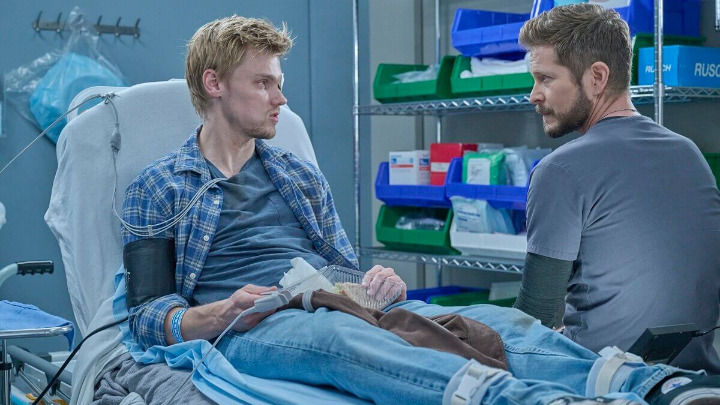
The surgical management in this episode showcases the heartbreaking limits of modern medicine and the immense psychological burden placed on surgeons who must know when to stop operating.
When Dr. Austin and Dr. Leela Devi opened Enrique's abdomen to fix the partial bowel obstruction, they intended to perform a bowel resection—cutting out the diseased portion of the colon and reconnecting the healthy ends. However, the discovery of diffuse peritoneal carcinomatosis completely halted their surgical plan. Because the malignant tumors were so extensive, coating virtually every surface of the abdominal cavity, the surgeons recognized that they were entirely unable to remove the cancer. Attempting to resect the primary tumor in the presence of such overwhelming metastatic disease would offer no survival benefit and would only subject the patient to immense surgical trauma, prolonged recovery, and a severely diminished quality of his remaining life.
The medical team was forced to perform what is colloquially and grimly known as a "peek and shriek" or an "open and close" procedure. They closed the abdominal incision without performing any further intervention. Following the surgery, the doctors had to deliver a terminal prognosis to Enrique. While surgical cure was impossible, his treatment plan pivoted entirely to palliative care. He was immediately referred to a medical oncologist to discuss palliative chemotherapy regimens. These treatments would not cure the cancer, but they might slow the tumor growth, temporarily relieve the symptoms of the bowel obstruction, and buy him a short amount of time to put his affairs in order.

A Curious Medical Fact: The Tragic Reality of the "Peek and Shriek"
One of the most grim and fascinating aspects of general and oncological surgery highlighted in Enrique's case is the concept of the "peek and shriek." This is dark, unofficial medical slang used by surgeons to describe a diagnostic laparotomy (an open abdominal surgery) that is terminated almost immediately after it begins. In the era before highly advanced, high-resolution CT and PET/MRI scans, these exploratory surgeries were quite common to determine the stage of a cancer.
Today, advanced imaging usually prevents surgeons from opening a patient whose cancer is already widely metastatic. However, in emergency situations like a bowel obstruction following a trauma, there is often no time for a staging PET scan; the patient must be opened immediately to save their life. The "shriek" (an internal reaction of dread from the surgical team) occurs when they open the peritoneum and instantly realize the imaging failed to capture the true, devastating extent of the disease. Closing a patient without fixing them is considered one of the most psychologically difficult tasks a surgeon must perform, as it runs entirely counter to their fundamental training to intervene, repair, and cure.

🔖 Key Takeaways
🗝️ Diffuse Peritoneal Carcinomatosis is an advanced, terminal stage of cancer where malignant cells have spread extensively throughout the lining of the abdominal cavity.
🗝️ Irritable Bowel Syndrome (IBS) masking cancer is a dangerous clinical trap; patients with chronic GI issues often mistakenly attribute new, deadly symptoms (like an obstruction) to their pre-existing condition.
🗝️ A Partial Bowel Obstruction is a mechanical blockage preventing digestive flow, often presenting as acute, severe abdominal pain that requires emergency surgical evaluation to prevent bowel ischemia.
🗝️ Early-onset colorectal cancer is rising significantly in adults under 50, frequently leading to late-stage diagnoses because these patients often fall outside traditional screening age brackets.
🗝️ An "Open and Close" laparotomy occurs when surgeons open an abdomen for an emergency but discover disease so advanced and diffuse that surgical intervention is impossible and futile.
🗝️ Palliative Oncology focuses on symptom management and quality of life, utilizing therapies to slow disease progression when a surgical or medical cure is no longer biologically possible.
Keywords: The Resident Medical Review S6E02
The Resident Medical Review S6E02


Comments