

The Resident TV Series Medical Review: Polycystic Kidney Disease, Polyarteritis Nodosa (S2E14 Review)
- Apr 16
- 8 min read
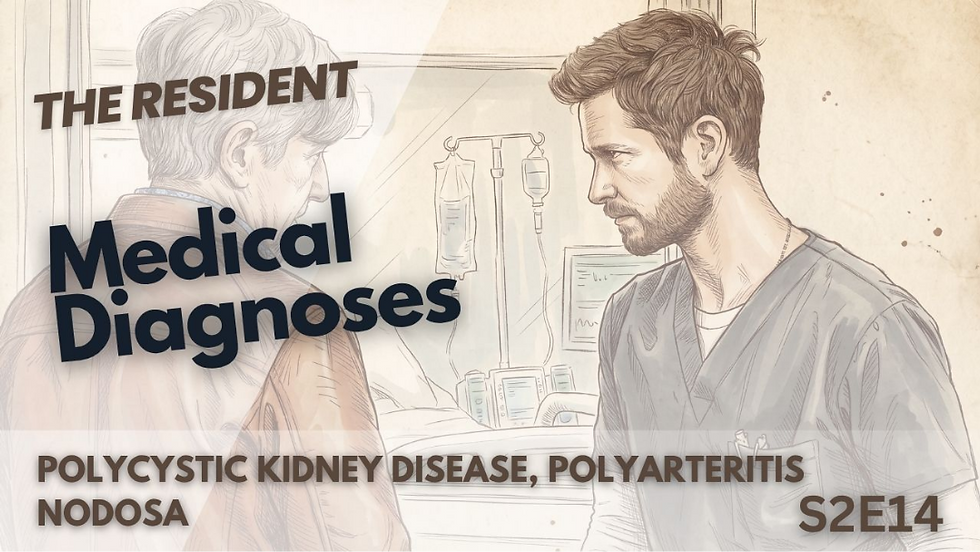
Medical television dramas consistently reach their most compelling narrative heights when they explore the fragile, unseen threads that connect generations, as well as the mysterious ways the human brain attempts to protect itself from its own decay. The fourteenth episode of this acclaimed series’ second season masterfully highlights these themes, taking viewers on a harrowing journey through the unintended consequences of assumptions in modern medicine. We are presented with two highly complex mysteries: a sudden death that holds a hidden, lethal warning for the living, and a patient whose physical collapse is masked by bizarre, seemingly impossible tales. Without revealing the overarching seasonal plotlines, the complex interpersonal relationships of the staff, or the ultimate administrative destiny of Chastain Park Memorial Hospital, this review will meticulously dissect the episode's central clinical cases. We will explore the deceptive presentations of genetic vascular anomalies, the exhaustive differential diagnoses navigated by the medical team, and the profound, life-saving interventions required when physicians refuse to accept the easiest answer.

Initial Presentation and the Emergency Room Visit
The clinical narrative of this episode is driven by an intense and chaotic emergency department, showcasing the sheer unpredictability of triage medicine. The central medical mystery begins with the devastating presentation of Gertie, a 70-year-old woman who is brought into the hospital completely unresponsive. Despite rapid emergency efforts, she is found asystolic—meaning there is a total absence of ventricular electrical activity in her heart, commonly known as a "flatline." While Gertie’s presentation tragically ends in death, it is the catalyst for the admission of her niece, Nora. Nora presents to the hospital not with a life-threatening trauma, but with persistent, throbbing headaches. In a bustling ER, a simple headache can easily be triaged as low-priority, but within the context of her aunt's sudden passing, her presentation takes on a much darker, more urgent tone.
Simultaneously, the internal medicine team evaluates Otto, a patient whose initial presentation is vague and deeply confusing. Otto arrives exhibiting profound physical weakness and visibly swollen, painful joints. However, his condition rapidly escalates from a general malaise to a terrifying respiratory emergency. He begins to experience massive hemoptysis—the coughing up of a large, life-threatening volume of bright red blood.
Amidst these critical cases, the Chastain emergency room manages a relentless influx of traumatic and orthopedic presentations. The surgical team stabilizes a patient suffering from a horrific Impalement, a traumatic injury where a foreign object has pierced the body. Miraculously, in this instance, it is a clean wound that entirely misses major bones and arteries. The orthopedic wing also evaluates acute skeletal traumas, treating patients with a painful Wrist Dislocation requiring immediate reduction and immobilization, and a severe Galeazzi Fracture—a highly specific break of the radial shaft associated with a complex dislocation of the distal radioulnar joint, which demands urgent surgical intervention.

History of Present Illness and Symptoms
In complex diagnostic medicine, a patient’s history is the fundamental blueprint for understanding their current crisis, but it can also be laden with misleading biases.
For Gertie, her history was heavily prejudiced by her age. Because she was a 70-year-old woman who died suddenly, hospital leadership hastily attributed her history of present illness to age-related Atherosclerosis—a common, progressive disease involving the buildup of plaque in the arteries that restricts blood flow and can easily cause sudden cardiac events. They assumed her death was a natural consequence of growing older. However, this assumption blinded them to the true, underlying history that was threatening her niece. Nora's history of persistent headaches was directly linked to the hidden genetic legacy she shared with her aunt.
Otto’s history, conversely, is a labyrinth of contradictions. His partner is deeply concerned about Otto's recent behavior, fearing a relapse into severe, chronic alcoholism. Otto's history is complicated by bizarre, fantastical stories; he recounts vivid, elaborate memories of recent trips to Paris and receiving personal blessings from the Pope. While his partner assumes he is lying to cover up alcohol abuse, these tall tales are actually a clinical symptom known as Confabulation. Otto is not intentionally deceiving anyone; his brain is fabricating memories to fill in profound neurological gaps. This cognitive history, combined with his physical history of swelling and weakness, paints a chaotic picture of systemic collapse.

The Vast Landscape of Differential Diagnoses
When patients present with multi-systemic failures or sudden, unexplained deaths, the medical team at Chastain must navigate a vast, chaotic landscape of differential diagnoses.
For Gertie, the easy, administrative differential was atherosclerosis leading to a fatal myocardial infarction. However, the doctors had to consider other silent killers, such as a massive pulmonary embolism or an undetected Arrhythmia—an irregular or abnormal heartbeat that can trigger sudden cardiac arrest. For Nora, her persistent headaches required the team to rule out stress, migraines, or severe hypertension, but Gertie's sudden death pushed the differential toward far more lethal structural anomalies in the brain.
For Otto, the combination of joint pain, weakness, and massive hemoptysis casts a terrifyingly wide diagnostic net. The team initially evaluates him for severe Anemia, a condition where the blood lacks enough healthy red blood cells, which would explain his profound weakness. They also must immediately address his failing renal system, evaluating him for general Kidney Failure—the loss of the kidneys' ability to filter waste from the blood. To find the unifying cause of his bleeding lungs and failing kidneys, the team must consider aggressive vasculitis, systemic autoimmune disorders, or advanced, metastatic malignancies. Furthermore, his bizarre mental state requires a psychiatric and neurological differential, forcing the team to separate acute intoxication or substance withdrawal from permanent, structural Dementia and Brain Atrophy—a physical decline in cognitive function and loss of brain volume.

The Definitive Diagnoses: Clinical Clues and Confirmations

The brilliant diagnostic breakthroughs in this episode require the physicians to outright rebel against standard hospital protocols to uncover the truth.
Unsatisfied with the lazy diagnosis of atherosclerosis, Dr. Okafor and Dr. Pravesh perform a highly unorthodox, unauthorized autopsy on Gertie, cleverly disguised as a routine anatomy lesson for students. When they open her chest, they discover her coronary arteries are perfectly clear—atherosclerosis did not kill her. The true culprit is found in her skull and abdomen: Gertie suffered a massive, ruptured brain aneurysm, and her kidneys are massively enlarged and covered in thousands of fluid-filled cysts. The definitive diagnosis is Polycystic Kidney Disease (PKD).
Recognizing that PKD is a highly inheritable genetic condition, the doctors realize Nora is in grave danger. They immediately order a STAT MRI for Nora, which confirms the terrifying genetic link. Nora also has Polycystic Kidney Disease, and the scan reveals two unruptured, "ticking time bomb" aneurysms in her brain. Her headaches were the warning sirens her aunt never got.
For Otto, comprehensive laboratory results and a tissue biopsy finally unify his chaotic physical symptoms. He is diagnosed with Polyarteritis Nodosa, a rare, aggressive autoimmune disorder that attacks the medium-sized blood vessels, causing his kidney failure and the massive bleeding in his lungs. His psychiatric mystery is resolved via neuroimaging and cognitive testing. Otto's "trips to Paris" are diagnosed as Confabulation resulting from alcohol-induced Dementia and Brain Atrophy. His past, long-term alcoholism caused permanent, irreversible damage to the memory centers of his brain.
Etymology of the Diagnoses
"Polycystic" is derived from the Greek poly (meaning many) and kystis (meaning sac or bladder), literally describing an organ riddled with many fluid-filled sacs. "Aneurysm" comes from the Greek word aneurysma, meaning a widening or dilation. "Polyarteritis Nodosa" translates to the inflammation (-itis) of many (poly-) arteries (arter-) with the formation of nodes or nodules (nodosa). "Confabulation" stems from the Latin confabulari, meaning to converse or chat together, evolving in clinical medicine to mean the unconscious fabrication of narrative.
Pathophysiology
The pathophysiology of Polycystic Kidney Disease involves a genetic mutation (typically in the PKD1 or PKD2 genes) that disrupts the normal development of kidney tubule cells. Instead of forming healthy filtering tubes, the cells abnormally proliferate and secrete fluid, forming expanding cysts. Over decades, these cysts grow massively, crushing and destroying the healthy kidney tissue. Crucially, the genetic defect in PKD also affects the structural integrity of vascular smooth muscle cells throughout the body, making the blood vessels in the brain exceptionally weak and highly prone to ballooning outward (aneurysms) and rupturing.
Polyarteritis Nodosa is a systemic necrotizing vasculitis. Otto's immune system erroneously targeted his own medium-sized arteries. Immune complexes deposited in the vessel walls, triggering a massive inflammatory response that caused fibrinoid necrosis (tissue death) of the blood vessels. This weakening of the arterial walls in his lungs led to micro-aneurysms that ruptured, pouring blood into his airways (massive hemoptysis), while the inflamed, narrowed vessels in his kidneys choked off blood supply, causing acute renal failure.
Real-World Epidemiology
Polycystic Kidney Disease is one of the most common, life-threatening genetic diseases in the world, affecting an estimated 1 in every 400 to 1,000 people. Brain aneurysms are a well-documented, highly lethal extra-renal complication of the disease. Polyarteritis Nodosa, however, is exceptionally rare, with an estimated prevalence of only about 30 cases per million adults. Alcohol-induced dementia, often associated with Wernicke-Korsakoff syndrome, is a tragic and prevalent consequence of chronic, severe alcohol use disorder, fundamentally altering the lives of thousands of patients and their families.

Aggressive Treatments and Medical Interventions

The medical interventions in this episode range from delicate, preventative neurosurgery to frantic, life-saving airway management.
To save Nora from suffering the exact same fatal fate as her aunt, the neurosurgical team performs a highly complex, preventative intervention. Through a delicate craniotomy or an endovascular approach, surgeons successfully isolate and repair the two ticking aneurysms in her brain, either by placing a titanium clip across the neck of the aneurysm to cut off its blood supply, or by packing it with platinum coils to induce clotting.
Treating Otto's massive hemoptysis is an immediate, terrifying critical care emergency. Because he is drowning in his own blood, the medical team must aggressively secure his airway. They utilize a specialized double-lumen endotracheal tube. This advanced piece of equipment allows the physicians to independently ventilate each lung, effectively isolating the bleeding lung to prevent the blood from spilling over and drowning the remaining healthy lung. Once his airway is secure, Otto is treated with powerful immunosuppressive medications and high-dose corticosteroids to halt the autoimmune attack of the Polyarteritis Nodosa. While these medications effectively stabilize his physical health and halt his kidney failure, the tragic reality of his case remains: his cognitive damage and brain atrophy are permanent, meaning his dementia and confabulations cannot be cured.

A Curious Clinical Fact: The Phenomenon of "Honest Lying"
One of the most fascinating and heartbreaking clinical realities explored in Otto's case is the concept of Confabulation, sometimes referred to in neurology as "honest lying." When severe, long-term alcohol abuse destroys the mammillary bodies and the thalamus of the brain (often due to thiamine deficiency), the patient develops severe anterograde amnesia—the inability to form new memories. However, the human brain abhors a vacuum. When confronted with a gap in memory, a confabulating patient's brain will spontaneously generate a fabricated, often highly detailed and plausible story to fill the void. The patient is not intentionally deceiving anyone; their damaged brain presents these fabricated stories to them as absolute, undeniable truth. When Otto spoke of the Pope and Paris, he wasn't lying to his partner—in his damaged reality, he genuinely believed he had just returned from France.

🔖 Key Takeaways
🗝️ Unauthorized autopsies can reveal hidden truths: Challenging assumptions based on a patient's age (like presumed atherosclerosis) can uncover genetic diseases that pose an immediate threat to surviving family members.
🗝️ PKD is a systemic vascular threat: Polycystic Kidney Disease does not just destroy the kidneys; the genetic mutation severely weakens blood vessels, creating a high risk for lethal brain aneurysms.
🗝️ Polyarteritis Nodosa destroys medium arteries: This rare autoimmune disorder causes severe inflammation and necrosis in blood vessels, leading to catastrophic organ failure and massive internal bleeding like hemoptysis.
🗝️ Massive hemoptysis requires lung isolation: When a patient is coughing up lethal amounts of blood, a double-lumen endotracheal tube is critical to isolate the bleeding and protect the healthy lung from drowning.
🗝️ Chronic alcoholism causes permanent brain atrophy: Severe, long-term alcohol abuse physically shrinks the brain and destroys memory centers, leading to irreversible dementia.
🗝️ Confabulation is not intentional deception: Patients with specific types of brain damage unconsciously fabricate elaborate stories to fill memory gaps, genuinely believing their "honest lies" as absolute reality.
Keywords: The Resident Medical Review S2E14
The Resident Medical Review S2E14



Comments