

The Resident TV Series Medical Review: Hemochromatosis, Temporal Lobe Epilepsy, Necrotizing Fasciitis (S3E04 Review)
- Apr 22
- 9 min read
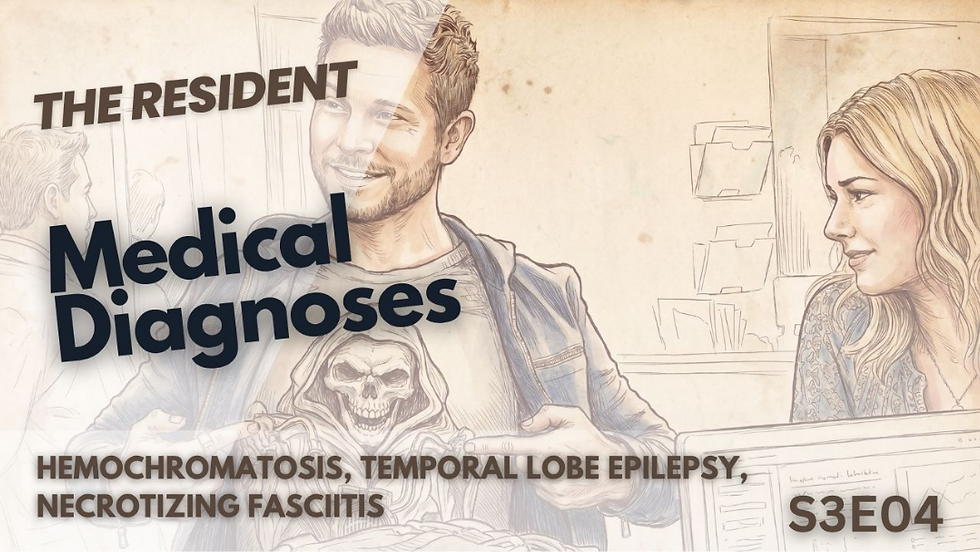
Medical television dramas consistently reach their most captivating narrative heights when they explore the absolute fringes of human biology, where seemingly supernatural phenomena and psychiatric mysteries collide with hard, empirical science. The fourth episode of this acclaimed series’ third season delivers a staggering look at the bizarre and the terrifying, forcing the brilliant medical team at Chastain Park Memorial Hospital to look far beyond initial assumptions. We are presented with a patient who miraculously returns from the dead, a psychological enigma masquerading as a neurological disorder, and a rapidly spreading, flesh-eating infection exacerbated by modern infrastructural decay. Without revealing the overarching seasonal plotlines, the complex interpersonal conflicts of the surgical staff, or the ultimate destinies of Chastain’s administration, this review will meticulously dissect the episode's central clinical emergencies. We will explore the deceptive presentation of rare genetic disorders, the exhaustive differential diagnoses navigated by the trauma and neurology teams, the terrifying pathophysiology of rapidly progressing bacterial infections, and the extreme, sometimes regrettable surgical interventions required when human anatomy breaks all the standard rules.

Initial Presentation and the Emergency Room Visit
The clinical narrative of this episode is driven by a tense juxtaposition of horrifying community emergencies and baffling physiological anomalies. The most jaw-dropping presentation belongs to a young man named Remy. His medical journey begins not with a set of symptoms, but with a confirmed death. After collapsing at a local mall, Remy undergoes unsuccessful cardiopulmonary resuscitation (CPR) and is officially pronounced dead by paramedics. However, to the absolute shock of the medical staff and bystanders, he experiences a dramatic, spontaneous "resurrection"—a rare medical phenomenon known as Lazarus Syndrome. By the time he arrives at Chastain, he is alive but highly unstable, presenting with life-threatening cardiac rhythms, specifically Ventricular Tachycardia (V-tach), a rapid, lethal heart rhythm originating in the ventricles that prevents the heart from pumping enough oxygenated blood to the body.
Simultaneously, the neurosurgery department evaluates Douglas Atwater, an inflammatory and highly controversial social media figure known by his online persona, "Hades." Douglas is admitted to the hospital following a terrifying neurological presentation: a Sentinel Bleed. This minor preliminary leak from a known vascular malformation in his brain serves as a blaring warning sign of an impending, catastrophic major rupture. His presentation is a ticking time bomb, requiring immediate surgical planning to prevent a fatal stroke.
Far from the high-tech corridors of Chastain, the episode also follows a rural emergency in a town suffering from the devastating closure of its local hospital. A woman named Sonya presents to a makeshift clinic with a rapidly progressing, horrifying infection on her arm. Her initial presentation is characterized by angry blisters, deep, necrotic ulcers, and mixed delirium. What started as a minor complaint has rapidly escalated into a limb-threatening and life-threatening crisis, requiring immediate, aggressive triage in a facility ill-equipped to handle it.

History of Present Illness and Symptoms
In complex diagnostic medicine, a patient’s history is often the only map to their underlying pathology, even when that history involves highly unconventional lifestyles. For Remy, his history of present illness is heavily obscured by his bizarre social practices. Once stabilized from his V-tach and Lazarus event, imaging and lab work reveal that he is suffering from severe Dilated Cardiomyopathy (where the heart's ventricles become enlarged and severely weakened) and significant Liver Damage. The crucial historical clue emerges when Remy and his partner Bella reveal they lead a "vampire" lifestyle, which routinely involves consuming each other's blood.
Douglas Atwater’s history of present illness is deeply intertwined with a complex psychiatric history. He claims to suffer from Dissociative Identity Disorder (DID), formerly known as multiple personality disorder, stating that the hateful, inflammatory "Hades" is an alternate personality that takes control of his behavior, while his true self is the mild-mannered "Doug." Alongside this psychiatric history, he has a known medical history of Hypertension, a condition of abnormally high blood pressure that acts as a critical concern, as it can easily trigger the rupture of his pre-existing vascular malformation.
Sonya’s history is a tragic reflection of environmental and infrastructural failure. Her history of present illness involves a simple skin wound that failed to heal. Her initial treatment with standard antibiotics like penicillin completely failed to halt the infection's spread. The terrifying historical context is that the local water supply in her town had been contaminated with pharmaceutical waste, creating a toxic environment that likely fostered the growth of highly resistant, aggressive superbugs, rendering standard first-line therapies useless.

The Vast Landscape of Differential Diagnoses
When patients present with such extreme and bizarre symptoms, the medical team must aggressively prioritize their differential diagnoses to avoid lethal missteps.
For Remy, the combination of dilated cardiomyopathy, liver damage, and a "vampire" lifestyle creates a highly unusual differential. The team must initially consider blood-borne infectious diseases (like Hepatitis B, C, or HIV) transmitted through the ingestion of his partner's blood. They must also rule out acute toxic ingestion or heavy metal poisoning that could account for both the sudden cardiac collapse and the hepatic injury.
For Douglas, the differential diagnosis bridges the complicated gap between psychiatry and neurology. While he carries a psychiatric diagnosis of Dissociative Identity Disorder, the presence of a known vascular malformation forces the neurosurgical team, led by Dr. Barrett Cain, to consider organic, physical causes for his behavioral shifts. The team must differentiate between genuine psychological trauma resulting in DID and a primary neurological misfire causing personality alterations.
For Sonya, the rapidly spreading blisters and ulcers on her arm require an immediate, aggressive differential diagnosis to stave off impending Sepsis—an extreme, life-threatening systemic response to an infection that causes rapid organ failure. The team must differentiate between severe but manageable cellulitis, a localized abscess, or the ultimate nightmare scenario: a deep tissue, rapidly spreading necrotizing infection.

The Definitive Diagnoses: Clinical Clues and Confirmations

The brilliant diagnostic breakthroughs in this episode require the medical team to look past the bizarre and uncover the rare, underlying systemic truths.
For Remy, his "vampirism" provides the paradoxical key to his definitive diagnosis. Blood tests confirm that Remy suffers from Hemochromatosis, a genetic condition where the body absorbs and stores massive, toxic amounts of excess iron. The iron overload was poisoning his vital organs, directly causing his liver damage and his dilated cardiomyopathy, which in turn triggered his fatal V-tach. Paradoxically, his bizarre lifestyle of bloodletting (drinking blood required drawing it first) may have accidentally and briefly mitigated his illness by mimicking the actual medical treatment for the disease.
For Douglas, an MRI reveals a terrifying anatomical truth: alongside an Arteriovenous Malformation (AVM)—a congenital, abnormal tangle of blood vessels bypassing the capillary system—he has severe Mesial Temporal Lobe Sclerosis (inflammatory scarring). Dr. Cain concludes that Douglas’s "alternate" personality is not a psychiatric condition (DID) at all, but rather a manifestation of Temporal Lobe Epilepsy caused by the sclerotic tissue. The electrical misfires (seizures) in his temporal lobe were directly altering his behavior and personality.
For Sonya, the clinical presentation of rapidly spreading necrosis, profound pain out of proportion to the visible injury, and failing antibiotics leads to the grim, definitive diagnosis of Necrotizing Fasciitis, colloquially known as "flesh-eating disease." The contaminated local water had indeed bred an antibiotic-resistant superbug that was rapidly destroying her fascia and muscle tissue.
Etymology of the Diagnoses
"Hemochromatosis" is derived from the Greek haima (blood), chroma (color), and the suffix -osis (condition), originally describing the bronze discoloration of the skin seen in advanced cases. "Sclerosis" comes from the Greek sklerosis, meaning a hardening or scarring of tissue. "Necrotizing Fasciitis" combines necrotizing (causing tissue death) with fasciitis (inflammation of the fascia, the connective tissue surrounding muscles).
Pathophysiology
The pathophysiology of Remy's Hemochromatosis involves a mutation in the HFE gene, causing his intestines to absorb iron from his diet at a highly unregulated, accelerated rate. Because the human body lacks a natural mechanism to excrete excess iron, the toxic metal deposits directly into the parenchymal cells of the liver, heart, and pancreas, causing oxidative stress, tissue scarring, and eventually, profound organ failure.
Douglas's dual neurological diagnoses present a lethal combination. The AVM is a high-pressure tangle of arteries and veins lacking a dampening capillary bed, making it highly prone to rupturing (sentinel bleeds). Simultaneously, the mesial temporal lobe sclerosis creates a focus of hyperexcitable neurons. When these neurons misfire (temporal lobe epilepsy), they cause complex partial seizures that can manifest as profound alterations in consciousness, mood, and personality, mimicking dissociative psychiatric disorders.
Sonya's Necrotizing Fasciitis is a rapidly progressive bacterial assault. The antibiotic-resistant superbugs infiltrate the deep fascial planes separating the muscles. They release highly destructive toxins and enzymes that cause widespread microvascular thrombosis (blood clots in tiny vessels), cutting off the blood supply to the tissue. This results in rapid, liquefactive necrosis (tissue death) that spreads centimeters per hour, inevitably leading to fatal septic shock if not mechanically stopped.
Real-World Epidemiology
Hemochromatosis is actually one of the most common genetic disorders in the United States, predominantly affecting individuals of Northern European (Celtic) descent, though it often goes undiagnosed until severe organ damage occurs in middle age. AVMs are rare, congenital defects occurring in less than 1% of the population. Necrotizing Fasciitis is a rare but terrifyingly lethal infection; even with optimal medical and surgical treatment, the mortality rate can reach 25% to 30%, highlighting the absolute necessity of immediate, aggressive intervention.

Aggressive Treatments and Medical Interventions

The medical interventions depicted in this episode showcase the brutal, high-wire reality of advanced surgical repair and the tragic consequences of medical hubris.
To treat Remy's Hemochromatosis, the intervention is surprisingly archaic but highly effective: therapeutic phlebotomy. He must undergo regular, pint-sized blood draws to physically remove red blood cells (which contain iron) from his body, forcing his bone marrow to use the toxic, stored iron in his organs to make new blood. He is also strictly counseled to avoid excess iron intake.
Sonya's treatment requires desperate, heroic measures. Because necrotizing fasciitis destroys the blood vessels supplying the tissue, intravenous antibiotics cannot physically reach the infection site. To save her life from impending sepsis, the doctors are forced to break into and temporarily reopen the shuttered local hospital. They perform an emergency surgical debridement—wielding scalpels to physically cut out and remove all the dead and infected skin, fascia, and muscle tissue until they reach healthy, bleeding margins, physically halting the spread of the flesh-eating bacteria.
For Douglas, the surgical intervention ends in a horrifying psychiatric miscalculation. Dr. Barrett Cain performs a highly complex craniotomy and resection, successfully removing the dangerous AVM to prevent a fatal stroke. He also cuts out the scarred, sclerotic tissue, arrogantly believing he is "cutting out" the hateful Hades persona by curing the epilepsy. However, a post-operative review of his psychiatric records reveals a devastating truth: "Doug" was the alternate personality created by the seizures to cope with the trauma. By curing the epilepsy and removing the tissue, Cain successfully "unchained" the original, malevolent personality. The surgery was an anatomical success, but a psychological catastrophe.

A Curious Clinical Fact: The Mechanics of Lazarus Syndrome
The episode's opening featuring Remy’s return from the dead highlights one of the most fascinating and baffling phenomena in emergency medicine: Lazarus Syndrome. Medically termed "auto-resuscitation after failed cardiopulmonary resuscitation," it involves the spontaneous return of circulation after a patient has been officially pronounced dead. But how does it happen? The leading medical theory suggests that during prolonged, aggressive CPR, hyperinflation of the lungs can cause immense, trapped pressure to build up inside the chest cavity (dynamic hyperinflation). This massive pressure physically compresses the heart and the major veins, preventing blood from returning to the heart. When CPR is halted and the patient is declared dead, this trapped intrathoracic pressure slowly releases. Once the pressure normalizes, blood is finally able to rush back into the heart, which can spontaneously trigger the heart's electrical system to reboot and restart a pulse on its own, seemingly bringing the patient back from the dead.

🔖 Key Takeaways
🗝️ Lazarus Syndrome is a rare physiological rebound: Spontaneous return of circulation after CPR is halted can occur when trapped intrathoracic pressure is finally released, allowing the heart to restart.
🗝️ Hemochromatosis causes toxic organ failure: A genetic inability to regulate iron absorption leads to massive, toxic iron deposits in the heart and liver, causing dilated cardiomyopathy and liver damage.
🗝️ Therapeutic phlebotomy is a modern medical necessity: The primary treatment for iron overload is regular, controlled bloodletting to physically remove iron stores from the body.
🗝️ Neurology can mimic psychiatry: Temporal lobe epilepsy caused by mesial temporal lobe sclerosis can manifest as profound personality changes, often leading to misdiagnoses like Dissociative Identity Disorder.
🗝️ Surgical hubris carries massive psychological risks: Altering brain tissue to cure epilepsy can have profound, irreversible effects on a patient's personality and psychiatric baseline, as seen in the tragic "unchaining" of Hades.
🗝️ Necrotizing Fasciitis requires immediate the blade: Flesh-eating bacteria destroy local blood supply, making antibiotics useless; survival depends entirely on immediate, aggressive surgical debridement to cut out the infection.
🗝️ Contaminated environments breed lethal superbugs: Modern infrastructural decay and pharmaceutical waste in water supplies can foster antibiotic-resistant bacteria, turning minor cuts into limb-threatening emergencies.
Keywords: The Resident Medical Review S3E04
The Resident Medical Review S3E04



Comments