

New Insights Into Sleep Uncover Key Neural Mechanisms Related to Enhanced Cognitive Function
- 14 dic
- 3 Min. de lectura

The complex relationship between sleep and brain performance continues to be illuminated by scientific discovery, particularly concerning nonrapid eye movement (NREM) sleep and the critical moments of awakening. Recent research, focused on uncovering the underlying neural mechanisms, is fundamentally changing how we understand sleep’s restorative power and opening doors for artificial ways to boost cognitive function.
While it is broadly accepted that sleep improves cognitive performance, the precise mechanisms, especially those related to NREM sleep, have remained largely unexplored. NREM sleep is the lighter stage experienced during a nap, and a study involving macaques revealed how this stage enhances both neuronal and behavioral performance. Researchers monitored neural activity across three brain areas—including visual cortices and the prefrontal cortex—as the animals performed a visual discrimination task before and after NREM sleep.
The findings showed that sleep improved the animals’ accuracy in distinguishing rotated images, a boost not observed in macaques that remained quietly awake. This enhancement was tied to a significant shift in brain activity: although NREM sleep fosters brain synchronization, the period after sleep is marked by Neural Desynchronization. This allows neurons to fire more independently, resulting in improved accuracy in information processing and enhanced performance.
Crucially, researchers successfully replicated this performance-enhancing effect using Brain Stimulation. They applied low-frequency electrical stimulation (4-Hz, mirroring the delta frequency seen in NREM sleep) to the visual cortex of awake animals. This artificial stimulation effectively reproduced the desynchronization effect seen after actual sleep, similarly enhancing the animals’ task performance. This discovery is significant because it suggests the performance-enhancing effects of sleep might be achieved artificially, potentially leading to new neuromodulation therapies to improve Cognitive Function or treat sleep disorders when actual sleep is not feasible, such as during space exploration.
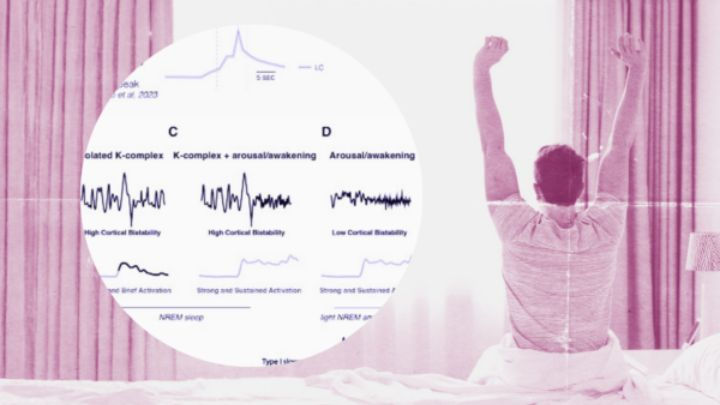
Complementing these insights into sleep's effects, researchers have also studied the transition to wakefulness, analyzing over 1,000 awakenings. They uncovered a strikingly consistent signature: the brain does not wake all at once, but rather orchestrates a moving wave of activity that starts in central and frontal regions and gradually spreads toward the back of the brain. This sequence is thought to reflect how arousal signals from deeper brain centers reach the cortex.
Awakening patterns differ based on the preceding sleep stage. Waking from non-REM sleep involves a brief surge of slow, sleep-like waves immediately followed by faster, wakefulness activity, whereas REM awakenings skip these initial slow waves. Interestingly, while some slow waves act as "arousal elements" that increase alertness, other persisting slow waves are responsible for the feeling of sleepiness upon waking. Understanding this process could aid future research into conditions involving incomplete awakenings, like certain sleep disorders.
Finally, new techniques are being developed toward Objective Fatigue Assessment. Researchers used advanced imaging and computational analysis in mouse models to track active neurons and networks with single-cell resolution throughout the day. The research revealed that as mice progress through their day, activity shifts from inner (subcortical) brain layers toward the cortex at the surface. The ultimate goal is to identify objective "signatures" of fatigue, moving beyond unreliable subjective tiredness assessments to ensure professionals like surgeons and pilots are adequately rested. Although the experimental techniques used involved mice, the computational methods developed are generalizable to human data gleaned from EEG, PET, and MRI scans.
These collective findings offer a deep, mechanistic understanding of sleep’s role in Cognitive Function and point toward a future where brain stimulation and objective measurement tools can enhance performance and safety.
🔖 Sources


Keywords: Enhanced Cognitive Function
Enhanced Cognitive Function

