

Grey's Anatomy TV Series Medical Review (S3E5)
- Mar 31
- 6 min read
Welcome to the morning after the storm, colleagues. If you thought your last Morbidity and Mortality (M&M) conference was a firing squad, try being Miranda Bailey today. Between interns cutting LVAD wires and others sitting on multi-million dollar inheritance checks, the halls of Seattle Grace are more "code blue" than "coffee break". Today’s rounds are a masterclass in how guilt, hormones, and hubris can clutter a clinical picture faster than an unorganized crash cart.
We started the day with a complex presentation: a 30-year-old mother who discovered a breast mass while nursing. She initially attributed the finding to a common lactation complication, but the progression has landed her in a surgical consult for definitive management.
Down in the pit, we had a "joined at the hip"—or rather, joined at the pelvis—situation that would make even a seasoned attending blush. A divorced couple arrived physically inseparable following a private encounter, presenting with acute entrapment and localized vaginal pain. The situation took a turn for the worse when the male half of the duo suddenly developed acute, tearing chest pain immediately following their separation.
Finally, the Chief gave us a sobering reminder of our history: a retrospective look at a patient who suffered a catastrophic neurological event following a heart transplant, and a "ghost" case of a stable cardiac patient who suddenly decompensated during transport.

Stage 2B Breast Cancer

Diagnosis
Stage 2B Breast Cancer.
Definition
A malignant proliferation of epithelial cells in the breast. Stage 2B indicates a tumor between 2-5 cm with spread to 1-3 axillary lymph nodes, or a tumor larger than 5 cm without node involvement. It requires aggressive intervention and has a 5-year survival rate of approximately 80-90% with modern treatment.
Patient
Anna Nyles.
Case Summary
Anna, a young mother, initially ignored a breast lump, assuming it was a clogged milk duct from breastfeeding. By the time she sought help, the cancer had advanced. She struggled with intense guilt, even admitting she "resented" her baby’s presence because the lactation delayed her diagnosis. After a heart-to-heart with Dr. Bailey regarding maternal humanity, she moved forward with her surgical plan.
Care Team
Mark Sloan (Plastic Surgeon), Miranda Bailey (Surgical Resident), Alex Karev (Surgical Intern).
Treatment
Mastectomy and subsequent breast reconstruction using either saline or silicone implants.
What they did wrong
The sources suggest a significant diagnostic delay. Because Anna was 30 and breastfeeding, the doctors (and the patient) initially attributed the lump in her breast to a clogged milk duct rather than investigating it as a potential cancer. This allowed the cancer to advance to Stage 2B before being correctly identified.
What they did right
Once diagnosed, the hospital provided a multidisciplinary approach. They didn’t just schedule a mastectomy; they brought in a plastic surgeon (Mark Sloan) to discuss reconstructive options, including the pros and cons of saline versus silicone implants. Furthermore, Dr. Bailey utilized patient-centered care by sharing her own struggles as a mother to empathize with Anna’s fear and guilt, eventually helping the patient choose to proceed with the life-saving surgery.

Foreign Body Entrapment (Genitourinary)
Diagnosis
Foreign body (Mechanical Entrapment).
Definition
The presence of an endogenous or exogenous object lodged in a body cavity. In this rare clinical scenario, mechanical interlocking occurred between a metallic penile piercing and the arms of an intrauterine device (IUD), leading to tissue impingement and inability to separate without medical intervention.
Patient
Sonya Cowlman and Adam Morris.
Case Summary
The divorced couple was "reconnecting" when Adam’s penile piercing became hooked on Sonya's IUD, which had dislodged from her uterus and snagged her vaginal wall. They were brought in physically attached, much to the horror of their daughter, who found them in the ER.
Care Team
Addison Montgomery (OB/GYN), Meredith Grey (Surgical Intern), Cristina Yang (Surgical Intern).
Treatment
Controlled extraction via X-ray guidance; doctors manipulated the piercing and IUD until they could be safely unhooked and separated.
What they did wrong
The doctors attempted a "controlled extraction" by physically manipulating and "rotating" the two patients while they were still physically joined. The extreme physical and emotional stress of this public, painful, and "embarrassing" situation likely contributed to Adam Morris suffering a myocardial infarction (heart attack) and a subsequent aortic dissection during the procedure.
What they did right
The team correctly used X-rays to identify exactly how the penile piercing was hooked onto the IUD before attempting to move it. Once the aortic dissection was identified—a "code blue" emergency—they moved Adam immediately to the operating room for a successful repair.

Myocardial Infarction and Aortic Dissection
Diagnosis
Myocardial Infarction and Aortic Dissection.
Definition
A Myocardial Infarction (MI) is the irreversible necrosis of heart muscle due to prolonged ischemia. An aortic dissection is a life-threatening condition where a tear in the inner layer of the aorta allows blood to flow between the layers of the aortic wall, potentially leading to rupture.
Patient
Adam Morris.
Case Summary
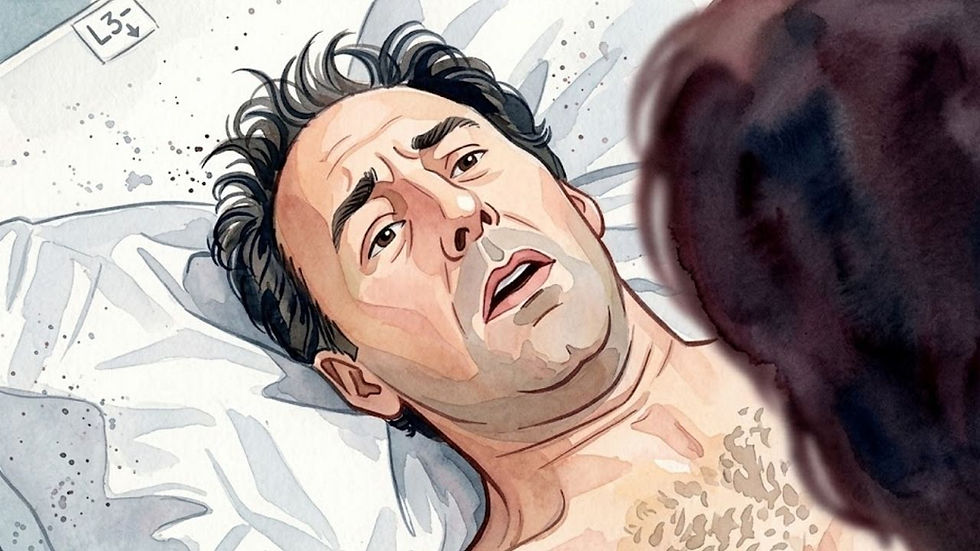
Immediately after the physical trauma and stress of being separated from Sonya, Adam suffered a heart attack (MI) followed by his aorta "bursting" (dissection).
Care Team
Preston Burke (Cardiothoracic Surgeon), Richard Webber (General Surgeon), Cristina Yang (Surgical Intern).
Treatment
Emergency cardiothoracic surgery. During the procedure, Cristina Yang performed a continuous running suture on the heart under Burke's guidance.

Congestive Heart Failure and Embolic Stroke (M&M Case)
Diagnosis
Congestive Heart Failure (CHF) and Embolic Stroke.
Definition
CHF is a chronic condition where the heart doesn't pump blood as well as it should. An embolic stroke occurs when a blood clot (embolus) forms elsewhere in the body—often the heart—and travels to the brain, blocking blood flow and causing brain tissue death.
Patient
Denny Duquette, Jr.
Case Summary
Denny was the subject of the Morbidity and Mortality report. After an intern cut his LVAD wires to move him up the transplant list, he eventually received a heart. However, an embolus dislodged from the transplant suture line, leading to a stroke and fatal brain stem herniation.
Care Team
Preston Burke (Cardiothoracic Surgeon), Miranda Bailey (Surgical Resident).
Treatment
Heart transplant and LVAD (previous), though the outcome was expiration.
What they did wrong
The primary "wrong" in this case was the lack of intern supervision and the gross violation of medical ethics when an intern (Izzie Stevens) cut the patient’s LVAD wires. During the Morbidity and Mortality (M&M) report, it was noted that the interns ignored pages and were "unsupervised" for hours. Additionally, the attending, Dr. Bailey, was criticized for a potential lapse in judgment or authority, possibly linked to her recent return from maternity leave.
What they did right
The hospital correctly utilized a Morbidity and Mortality (M&M) conference to review the case. While the show portrays this as a hostile environment, the stated purpose—discussing errors to learn from them rather than just assigning blame—is a hallmark of modern hospital safety culture.

Traumatic Pneumothorax (Retrospective)
Diagnosis
Pneumothorax (Ruptured Lung).
Definition
The accumulation of air in the pleural space between the lung and the chest wall causes the lung to collapse. A "tension" pneumothorax is a medical emergency where the air buildup shifts mediastinal structures and impairs cardiac output.
Patient
Unnamed (Richard Webber’s former patient).
Case Summary
Dr. Webber recounted a case from his intern year involving a stable cardiac patient who "blew a lung" while being transported to a CT scan.
Care Team
Richard Webber (as an intern).
Treatment
The patient required a chest tube, but because Webber waited for a code team instead of acting immediately, the patient died.

🔖 Key Takeaways
🗝️ This Grey’s Anatomy medical review highlights how delayed diagnosis in Stage 2B breast cancer can worsen outcomes, emphasizing early investigation even during breastfeeding.
🗝️ The LVAD case underscores severe ethical violations and a lack of supervision, showing how poor judgment can lead to fatal consequences despite advanced treatment.
🗝️ The foreign body entrapment case demonstrates how emotional stress and improper handling can escalate into life-threatening complications like myocardial infarction and aortic dissection.
🗝️ Emergency response and rapid surgical intervention were crucial in saving a patient with aortic dissection, reinforcing the importance of quick decision-making in critical care.
🗝️ The M&M conference reflects the importance of accountability and learning from medical errors to improve hospital safety culture.
🗝️ Retrospective analysis of pneumothorax highlights how hesitation in emergencies can cost lives, stressing the need for immediate action in trauma care.
Keywords: Grey's Anatomy S3E5
Grey's Anatomy S3E5


Comments