

The Resident TV Series Medical Review: Chiari Malformation (S3E05 Review)
- 5 days ago
- 8 min read
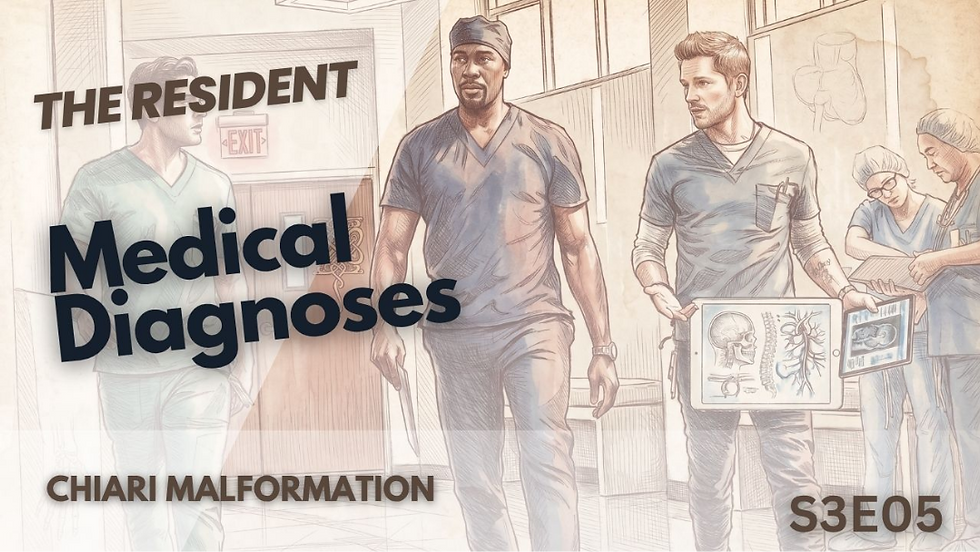
Medical dramas have a unique way of capturing our collective imagination, blending high-stakes emotional storytelling with the intricate, often baffling puzzles of human anatomy. When a patient crashes through the doors of a fictional emergency room, the unfolding mystery can be just as compelling as the most thrilling whodunit. In this breakdown, we are looking at a brilliant narrative of diagnostic discovery from The Resident. While the chaotic aftermath of a mass casualty event sets the stage, it is the quiet, lingering symptoms of a single patient that provide the episode's most profound medical lesson. Without giving away the ultimate fate of all our favorite Chastain Memorial doctors, let us step into their shoes and explore the fascinating medical journey of a patient whose life was defined by an elusive, decades-long misdiagnosis.

Initial Presentation and the Emergency Room Visit
The adrenaline-fueled environment of an emergency department during a mass casualty incident is a true test of triage and clinical acumen. In this episode, Susan Mitchka is brought into Chastain Memorial Hospital as a survivor of a devastating plane crash. Amidst the sirens and the rush of stretchers, Susan's initial physical trauma appears relatively straightforward: she presents with a visible scalp laceration, a common consequence of blunt force trauma sustained during the violent turbulence and impact of the crash.
However, emergency medicine is rarely as simple as addressing the first visible wound. Upon initial assessment, the medical team quickly realizes that the superficial cut on her head is the least of her worries. Susan is in the throes of a life-threatening hypertensive emergency. Her blood pressure has skyrocketed to critical levels, putting her at immediate risk for a stroke, aortic dissection, or catastrophic organ failure. The contrast between her localized physical injury and her severe, systemic physiological instability immediately sets off alarm bells for the medical staff, pivoting her care from routine trauma management to an acute, high-stakes medical intervention.

History of Present Illness and Symptoms
As the doctors work to stabilize her soaring blood pressure, Susan’s medical history comes to light, painting a heartbreaking picture of a woman burdened by chronic illness. At the tender age of nine, she was diagnosed with narcolepsy, a condition that has haunted her ever since. For decades, she has battled the overwhelming, uncontrollable urge to sleep during the day, a symptom that has undoubtedly shaped her social, personal, and professional life.
Alongside this debilitating neurological label, Susan has suffered from severe, chronic hypertension. What makes her cardiovascular profile so alarming is that her high blood pressure has proven wildly resistant to multiple lines of antihypertensive medications. This combination of "incurable" narcolepsy and intractable hypertension has left Susan deeply despondent. Believing she is forever tethered to a failing body and terrified of the financial ruin that would accompany losing her demanding career in sales, she nearly makes a fatal decision. Driven by desperation, she attempts to leave the hospital against medical advice (AMA). This moment highlights the profound psychological toll that chronic, poorly managed illness takes on a patient, where the fear of losing one's livelihood temporarily eclipses the immediate threat to one's life.

The Vast Landscape of Differential Diagnoses
To understand the complexity of Susan's case, we must view it through the lens of the chaotic ER environment depicted in the episode. When a plane crashes, a hospital is flooded with a myriad of traumas and exacerbated chronic conditions, forcing doctors to build wide and rapid differential diagnoses for multiple patients simultaneously. The sheer volume of medical crises featured in this narrative highlights the cognitive load placed on physicians.
For the various victims of the crash, the trauma bay becomes a masterclass in emergency pathology. The doctors are forced to evaluate and rule out severe structural traumas. They encounter patients suffering from a head injury—a broad diagnosis encompassing everything from mild concussions to severe traumatic brain injuries resulting from high-impact accidents. They must stabilize an unstable pelvis, a traumatic and often life-threatening injury involving multiple fractures of the pelvic ring that compromises structural integrity and risks massive internal hemorrhage. This is heavily complicated by anatomical variations like corona mortis, a lethal and notoriously difficult-to-control vascular connection in the pelvis that can lead to rapid exsanguination.
Other orthopedic and surgical emergencies flood the OR, including an open radial fracture, where the radius bone penetrates the skin, demanding urgent surgical fixation and aggressive antibiotic prophylaxis to prevent deep-seated bone infections. Accompanying this are cases of radial nerve injury, where the trauma has caused a loss of motor function and sensation in the arm, as well as severe cervical spinal damage, posing an immediate risk of permanent neurological impairment or paralysis. Abdominal traumas are equally represented, notably through splenic hemorrhage, requiring rapid splenectomy to halt severe internal bleeding.
Beyond blunt trauma, the physiological stress of the accident and hospitalization triggers a cascade of systemic issues. The medical team actively navigates the dangers of blood clots forming in the circulatory system. This hypercoagulable state forces them to monitor closely for a pulmonary embolism, a fatal complication where clots block the lung arteries—a scenario particularly dangerous for patients with compromised filtration, such as those on dialysis. Furthermore, the trauma reveals underlying chronic conditions in the patient population, ranging from alcohol use disorder—identified via elevated blood alcohol and liver enzymes—to profound anemia, often requiring erythropoiesis-stimulating agents, and unexplained tachycardia driven by stress, blood loss, or primary cardiac injury.
The doctors must also field cases involving long-term morbidities. They treat patients managing the devastating reality of cancer recurrence, noting how hormonal fluctuations can trigger the return of malignancies like ovarian cancer or the highly aggressive triple negative breast cancer, which lacks common receptors and carries a high early recurrence rate. They encounter patients with chronic nerve compressions causing radicular symptoms, such as a herniated disc compressing spinal roots, or peripheral neuropathies like carpal tunnel syndrome. Even seemingly unrelated issues arise in the clinical setting, such as a pterygium—a wing-shaped growth on the eye's conjunctiva—and severe kidney damage brought on by years of uncontrolled hypertension.
Against this staggering backdrop of concurrent medical crises, Susan's differential diagnosis requires a sharp, focused pivot. Her acute presentation initially suggests hypertensive encephalopathy, a brain dysfunction directly caused by her severely elevated blood pressure, which could impair her capacity to make safe medical decisions (like leaving AMA). However, her history of treatment-resistant hypertension and narcolepsy suggests something far more deeply rooted than simple essential hypertension. The doctors must discern what systemic link could possibly bridge a childhood sleep disorder with intractable cardiovascular disease.

The Definitive Diagnoses: Clinical Clues and Confirmations

The turning point in Susan's case arrives through sharp clinical observation. As she moves about, the medical team notices a subtle but undeniable neurological deficit: she exhibits a wide, staggering gait. This clinical sign is classic for cerebellar ataxia, indicating a lack of muscle control and coordination originating from the cerebellum—the part of the brain responsible for balance.
This specific neurological clue forces the team to entirely re-evaluate her lifelong medical history. If her cerebellum is compromised, her sleep issues might not be a primary sleep disorder at all. The doctors realize her childhood diagnosis of narcolepsy was a tragic misdiagnosis. She is actually suffering from central sleep apnea, a condition where the brain occasionally fails to send the proper signals to the breathing muscles during sleep. Unlike obstructive sleep apnea, which is a mechanical airway issue, central sleep apnea is a neurological failure. An MRI of her brain is ordered, which finally uncovers the root cause of her suffering: a Chiari malformation.
Etymology
The condition is named after Hans Chiari, an Austrian pathologist who first described the structural anomalies of the brain at the junction of the skull and spine in the late 19th century. In 1891, Chiari detailed the varying degrees to which the cerebellum herniates into the spinal canal, categorizing them into types that are still used in medical nomenclature today.
Pathophysiology
To understand why Susan suffered so severely, one must look at the structural mechanics of a Chiari malformation. In a healthy individual, the cerebellum and the brainstem sit comfortably within the posterior fossa, a designated space at the lower back of the skull. In a patient with a Chiari malformation, this bony space is congenitally abnormally small or misshapen. As the brain grows, the lower part of the cerebellum—specifically the cerebellar tonsils—is pushed downward through the foramen magnum, the large opening at the base of the skull where the spinal cord begins.
This herniation acts like a cork in a bottle. It restricts the normal, vital flow of cerebrospinal fluid (CSF) between the brain and the spinal cord. More critically in Susan's case, the displaced cerebellar tissue exerts direct, physical pressure on the brainstem. Because the brainstem controls autonomic functions—such as respiratory drive and heart rate—this compression disrupted her sleep breathing (causing central sleep apnea) and triggered an overactive sympathetic nervous system response, resulting in chronic, medication-resistant hypertension.
Epidemiology
Chiari malformations are more common than historically believed, largely due to the advent and widespread use of MRI technology, which has made visualization of the hindbrain routine. It is estimated that the condition occurs in slightly less than 1 in 1,000 individuals. Many people who have a mild anatomical Chiari malformation remain completely asymptomatic for their entire lives, with the anomaly only discovered incidentally during imaging for an unrelated issue. However, when symptomatic, it tends to present more frequently in women than in men, often manifesting in late childhood or early adulthood with headaches, neck pain, and balance issues.

Aggressive Treatments and Medical Interventions

With a definitive, structural cause identified, the management of Susan’s condition shifts from futile pharmacological management to definitive neurosurgery. The case is handed over to Dr. Cain, who performs a surgical decompression, specifically a posterior fossa decompression.
This intricate surgical procedure is designed to create more space for the herniated brain tissue and restore the normal flow of spinal fluid. Dr. Cain achieves this by removing a small section of bone at the back of the skull (suboccipital craniectomy) and often a portion of the first cervical vertebra. To further relieve the pressure, the surgeon opens the dura mater—the tough, outermost covering of the brain—and sews in a patch to enlarge it, much like letting out the waistband on a tight pair of pants.
The surgery is a resounding success. By physically removing the pressure from Susan's brainstem, the autonomic dysfunction is immediately corrected. Her central sleep apnea is cured, and without the constant neurological trigger, her chronic high blood pressure resolves. Waking up in the recovery room, Susan is no longer tethered to a failing body or a misdiagnosis that robbed her of her vitality. She finally gains the freedom and health required to pursue her demanding sales career and live a full life, unburdened by her symptoms.

A Curious Medical Fact: The Great Mimicker
One of the most fascinating clinical aspects of this episode's case is how easily central sleep apnea can mimic narcolepsy, particularly in pediatric patients. When a child presents with profound, uncontrollable daytime sleepiness, clinicians frequently suspect narcolepsy. However, when central sleep apnea wakes a patient hundreds of times a night—micro-arousals that the patient never remembers—the resulting daytime exhaustion is functionally identical to the sleep attacks of narcolepsy. Susan's case highlights a vital medical axiom: when a chronic condition fails to respond to standard, aggressive therapy, physicians must be willing to step back, reassess the earliest data points, and look for an underlying, unifying structural cause.

🔖 Key Takeaways
🗝️ Re-evaluating Chronic Misdiagnoses: Patients with long-standing, treatment-resistant symptoms (like Susan's narcolepsy and hypertension) often benefit from a complete re-evaluation, as structural neurological issues can masquerade as primary chronic diseases.
🗝️ The Brain-Heart Connection: Structural compression of the brainstem, such as that seen in a Chiari malformation, can directly cause severe, systemic cardiovascular issues like resistant hypertension by disrupting autonomic nervous system regulation.
🗝️ Cerebellar Ataxia as a Red Flag: A wide, staggering gait is a prime clinical indicator of cerebellar dysfunction, serving as a critical clue that guides physicians toward central nervous system pathologies rather than systemic or psychiatric causes.
🗝️ Trauma Masks Underlying Illness: In high-stress emergency environments, acute injuries (like scalp lacerations and traumatic fractures) can overshadow pre-existing, life-threatening conditions, requiring rigorous and continuous patient monitoring.
🗝️ The Efficacy of Decompression: Posterior fossa decompression surgery is a highly effective, definitive treatment for symptomatic Chiari malformations, capable of immediately resolving complex secondary symptoms like central sleep apnea.
Keywords: The Resident Medical Review S3E05
The Resident Medical Review S3E05



Comments