

Grey's Anatomy TV Series Medical Review (S3E7)
- Mar 31
- 6 min read
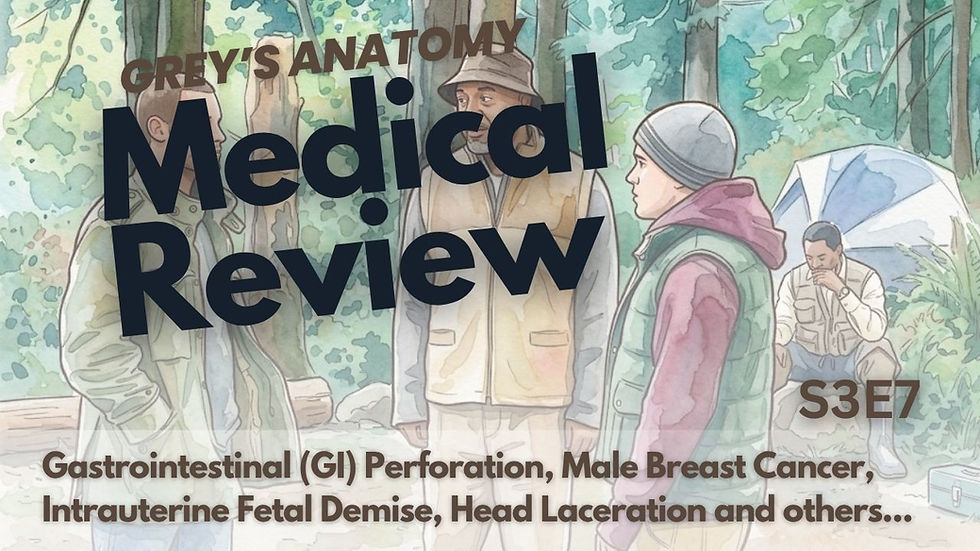
Welcome to the shift, everyone. Grab your coffee—make it a double—because today is one of those days where the hospital is buzzing, and the wilderness is, well, surprisingly surgical. While the "Mountain Men" (Shepherd, Burke, Webber, and the rest of our favorite residents) are out trying to find their Zen in the woods, the rest of us are back at Seattle Grace, dealing with the reality of what happens when the outside world crashes into the human body.
We’ve got a heavy board today. We’re looking at a pediatric patient who decided a Monopoly board looked like an all-you-can-eat buffet. We have a pregnant patient who took a devastating fall in the shower and is now presenting with a visible wrist deformity and a terrifying lack of fetal movement. There’s also a patient scheduled for a major reconstructive gender-affirming procedure whose routine pre-op workup has turned up an unexpected mass. And just to keep things interesting, even our "vacationing" surgeons couldn't escape the trauma, as a man in the woods had presented with a significant head wound after an encounter with a rock.
Let’s scrub in and look at the science behind the drama.

Gastrointestinal Perforation Secondary to Foreign Body Ingestion

Diagnosis
Gastrointestinal (GI) Perforation.
Definition
A GI perforation is a hole that develops through the wall of the esophagus, stomach, small intestine, or large bowel. It is often caused by the ingestion of sharp objects, corrosive substances, or—as seen here—blunt objects that cause pressure necrosis or obstruction. Symptoms include sudden, severe abdominal pain, rigidity, and signs of sepsis. It is a surgical emergency because it allows intestinal contents to leak into the abdominal cavity, leading to peritonitis.
Patient
Eric Sanborn.
Case Summary
Eric presented after intentionally swallowing 21 Monopoly pieces, including houses, hotels, and the car, to stop his brother from playing. While initially stable and passing some items naturally (monitored via sifting through his stool), Eric suddenly developed a rigid abdomen and began vomiting blood. He collapsed and was rushed to the OR to repair the perforation.
Care Team
Dr. Miranda Bailey (Surgical Resident), Dr. Cristina Yang (Intern), and Dr. Izzie Stevens (Intern).
Treatment
Exploratory laparotomy and surgical repair of the perforated digestive tract.
What they did wrong
The doctors initially opted for a "wait and see" approach, tasking an intern with manually sifting through the patient's stool to inventory 21 swallowed Monopoly pieces. While monitoring is common for small foreign objects, the delay in surgical intervention for such a large quantity of plastic items led to a perforation of the digestive tract. In modern medicine, manual stool sifting is largely unnecessary as serial imaging (X-rays) provides more accurate tracking without the hygienic risks.
What they did right
The medical team correctly used X-rays to track the progress of the items. Once the patient showed emergency symptoms—blood in his vomit, a rigid abdomen, and collapse—they correctly identified the perforation and moved immediately to surgery.

Male Breast Cancer
Diagnosis
Male Breast Cancer.
Definition
This is a rare malignancy that forms in the breast tissue of men. While rare, it is often more dangerous because it is frequently diagnosed at a later stage. Risk factors include aging, exposure to radiation, and high levels of estrogen (which can be caused by liver disease, obesity, or exogenous hormone therapy). Manifestations include a painless lump, skin dimpling, or nipple discharge. Prognosis depends heavily on the stage at diagnosis.
Patient
Donna Gibson.
Case Summary
Donna, a 34-year-old transgender woman, was admitted for a gender-affirming vaginoplasty. During her pre-operative workup, an aspiration of breast tissue revealed abnormal, cancerous cells. The cancer was being "fed" by the estrogen she was taking as part of her transition. Despite being advised to stop hormones and delay her transition to fight the cancer, Donna chose to proceed with the surgery, stating she would fight the disease "as a woman."
Care Team
Dr. Mark Sloan (Plastic Surgeon) and Dr. Meredith Grey (Intern).
Treatment
Hormone therapy (cessation of estrogen was recommended) and Vaginoplasty.
What they did wrong
Donna was advised to stop her hormone therapy because it was "feeding" her newly diagnosed breast cancer. Despite the medical risk that continuing hormones and proceeding with elective surgery could allow the cancer to worsen or result in death, the doctors allowed her to move forward with the vaginoplasty. In contemporary practice, elective gender-affirming surgery is typically postponed until a life-threatening malignancy is stabilized.
What they did right
The diagnosis was thorough; an aspiration of the breast tissue correctly identified abnormal cells. The doctors were also correct in their modern understanding that estrogen-based hormone therapy is a contraindication for certain types of breast cancer.

Intrauterine Fetal Demise (IUFD) and Distal Radius Fracture

Diagnosis
Intrauterine Fetal Demise and Broken Wrist.
Definition
IUFD refers to fetal death that occurs after the 20th week of pregnancy. It can be caused by trauma, placental abruption, or maternal infection. A distal radius fracture (broken wrist) often occurs after a fall on an outstretched hand (FOOSH), leading to pain, swelling, and deformity.
Patient
Jamie Carr.
Case Summary
Jamie slipped and fell in the shower, sustaining a fracture to her wrist. Upon arrival at the hospital, an ultrasound confirmed the most heartbreaking complication: there was no fetal heartbeat. Jamie had to endure the labor and vaginal delivery of her deceased son while also having her wrist fracture addressed.
Care Team
Dr. Addison Forbes Montgomery (OB/GYN) and Dr. Callie Torres (Orthopedic Surgery Resident).
Treatment
Manual realignment of the wrist bones (reduction) followed by casting, and a managed vaginal delivery for the fetal demise.
What they did wrong
After discovering through ultrasound that Jamie’s baby had died, the doctors chose to intentionally withhold the diagnosis for a period of time to let the parents "be happy" for a few more moments. This is a significant ethical violation of modern patient autonomy and the right to informed consent, as patients must be told of critical findings as soon as they are confirmed.
What they did right
Orthopedically, Callie Torres correctly used gravity to help align the bones in Jamie's broken wrist before casting it. Obstetrically, allowing the mother to labor, deliver, and hold her baby after a fetal demise is a standard modern practice to help parents process grief and find closure.

Scalp Laceration
Diagnosis
Head Laceration.
Definition
A scalp laceration is a tear in the skin of the head, often caused by blunt force trauma. Because the scalp is highly vascular, these wounds tend to bleed profusely. If deep, they require thorough irrigation to prevent infection and closure via sutures or staples.
Patient
Walter.
Case Summary
While on a camping trip with the "mountain men," Walter hit his head against a rock, causing a deep cut. Far from the sterile environment of Seattle Grace, the surgeons had to improvise using what they had on hand.
Care Team
Dr. Preston Burke (Cardiothoracic Surgeon).
Treatment
"McGyver-style" field medicine—sterilizing a fishing hook, removing the barb, and using it to provide stitches in the woods.
What they did wrong
Dr. Burke and Dr. Shepherd performed improvised surgery in the woods using a fishing hook. While they were on a camping trip, a simple head laceration rarely constitutes a "life-or-death" emergency that justifies using non-medical tools in an unsterile environment instead of seeking a nearby clinic.
What they did right
Given the field conditions, they followed proper "MacGyver" medical protocols by sterilizing the fishing hook and cutting off the barb to prevent further tissue damage while suturing.

Undisclosed Medical Emergency
(Admission to ER)
Diagnosis
Unspecified.
Patient
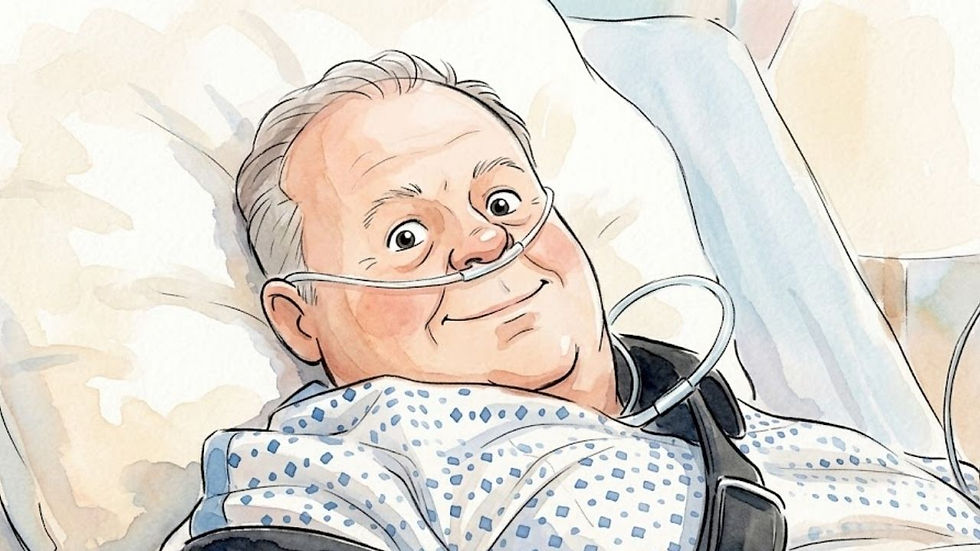
Harold O'Malley.
Case Summary
Harold (George's father) was brought into the Emergency Room. While the specific clinical details of his admission weren't shared with the team immediately, George was pulled aside by Callie and Dr. Bailey at the end of the shift to discuss his father’s status.
Care Team
Dr. Callie Torres.
Treatment
Initial ER stabilization and admission for further evaluation.

🔖 Key Takeaways
🗝️ Grey’s Anatomy S3E7 presents a mix of high-risk medical cases, blending surgical urgency with emotional storytelling.
🗝️ The GI perforation case highlights the dangers of delayed intervention in foreign body ingestion and the importance of timely surgery.
🗝️ The male breast cancer storyline explores hormone-related risks and raises ethical concerns about proceeding with elective surgery during active malignancy.
🗝️ The IUFD case underscores both proper obstetric care and a serious ethical lapse in withholding critical information from patients.
🗝️ Field medicine in the wilderness demonstrates improvisation skills but questions the necessity of non-sterile procedures.
🗝️ Overall, the episode balances medical realism with dramatic tension, showcasing both accurate practices and notable ethical violations.
Keywords: Grey's Anatomy S3E7 Review
Grey's Anatomy S3E7 Review




Comments