

Grey's Anatomy TV Series Medical Review (S3E8)
- Apr 6
- 7 min read

Grab a fresh cup of cafeteria sludge and listen up, because today’s shift at Seattle Grace was a masterclass in why we never, ever ignore the "blind spots" in our clinical judgment. We’ve got interns trying to be "bright and shiny", but the medicine? The medicine is as dark and twisty as it gets.
We started the day with a pediatric trauma that’ll make your heart sink—a five-year-old girl brought in with significant abdominal injuries and head trauma after a horrific accident with an SUV. Then, we had a VIP of sorts: Harold O'Malley, who came to us after a syncopal episode that resulted in a nasty fall and a fractured collarbone. To round out the chaos, we dealt with a post-op "aesthetic" patient complaining of localized swelling and fluid collection after a chest enhancement.
Here are your rounds for the day. Let’s look past the drama and focus on the science.

Stage III Metastatic Esophageal Cancer & Aortic Valve Regurgitation
Diagnosis
Stage III Metastatic Esophageal Cancer and a Leaking Aortic Valve.
Definition
Esophageal cancer is a malignancy of the lining of the esophagus, often linked to chronic irritation (like GERD). Stage III indicates the cancer has invaded the esophageal wall and spread to nearby lymph nodes or structures. Aortic valve regurgitation occurs when the heart's aortic valve doesn't close tightly, allowing blood to flow backward into the left ventricle, which can lead to heart failure if untreated.
Patient
Harold O'Malley.
Case Summary
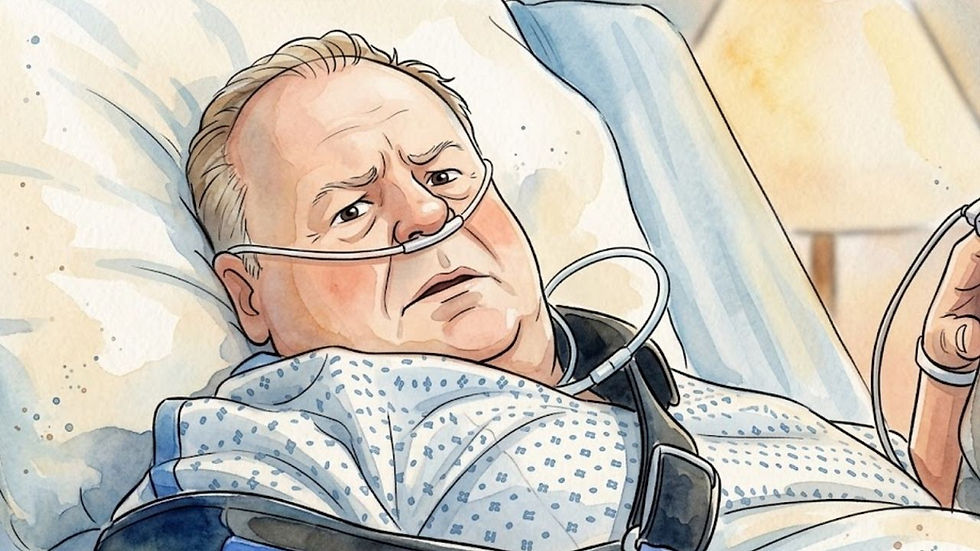
Mr. O'Malley was admitted after passing out and breaking his clavicle. While the orthopedic injury was straightforward, his complaints of abdominal pain prompted an endoscopy and biopsy. The results were devastating: esophageal cancer that had already metastasized to the stomach. Further pre-operative workup via ECG and echocardiogram revealed heart abnormalities, specifically a leaking aortic valve that was deemed too weak to withstand the stress of cancer surgery.
Care Team
Dr. Preston Burke (Cardiothoracic), Dr. Richard Webber (General Surgery), Dr. Callie Torres (Orthopedic Resident), Dr. Miranda Bailey (Surgical Resident), and Cristina Yang (Surgical Intern).
Treatment
Clavicle immobilization, followed by a scheduled aortic valve replacement to stabilize the patient for future cancer surgery and oncology treatments.
What They Did Wrong
Professional Ethics and Boundaries: While Dr. Bailey initially states that "families don't treat families," she allows George O’Malley to choose which of his fellow interns (Cristina Yang) will work on his father's case. In modern medicine, having a family member—especially a subordinate intern—influence the staffing or management of a relative's care is a major conflict of interest.
Breaking Bad News: The task of delivering a Stage III metastatic cancer diagnosis was left to Cristina, a surgical intern. Nowadays, such a life-altering diagnosis would typically be delivered by the lead attending (Dr. Webber) or a palliative care specialist to ensure the family receives the most accurate information and support.
Inappropriate Environment: George's brothers are allowed to treat the hospital room like a social lounge, even discussing car repairs while medical updates are being given.
What They Did Right
Holistic Diagnostic Approach: The team did not simply treat the fractured bone; they investigated why a healthy man would suddenly faint. Using an endoscopy, biopsy, and ECG to find the underlying cancer and heart abnormalities is consistent with modern diagnostic "workups" for syncopal episodes (fainting).

Traumatic Brain Injury (Intracranial Hemorrhage) & Abdominal Crush Injuries
Diagnosis
Skull Fracture, Brain Bleed (Hemorrhage), and Blunt Abdominal Trauma.
Definition
Blunt force trauma in pediatrics often results in multi-system injuries. A brain bleed, such as an epidural or subdural hematoma, involves a collection of blood within the skull that increases intracranial pressure, which can be fatal without rapid decompression. Abdominal crush injuries often involve damage to solid organs like the liver or kidneys.
Patient
Mia Hanson.
Case Summary
Five-year-old Mia was backed over by an SUV, presenting with tachycardia, hypotension (90/60), and blood in the ear canal—a red flag for a basilar skull fracture. She was rushed to surgery for her abdominal injuries. While initially appearing stable post-op, a follow-up MRI/CT confirmed the "blind spot": a brain bleed that was rapidly increasing pressure.
Care Team
Dr. Derek Shepherd (Neurosurgeon), Dr. Miranda Bailey (Surgical Resident), and Meredith Grey (Surgical Intern).
Treatment
Emergency exploratory laparotomy with cauterization to stop abdominal hemorrhaging, followed by a second surgery (craniotomy) to evacuate the brain bleed and relieve intracranial pressure.
What They Did Wrong
Trauma Room Chaos: The ER environment was highly volatile, with the parents and the nanny bickering loudly over the child. Modern pediatric trauma protocols emphasize "family-centered care" but often require a social worker or chaplain to manage distraught parents outside the immediate trauma zone to prevent interference with the medical team.
Professionalism in the OR: During surgery, Meredith Grey (an intern) begins criticizing the parents' lifestyle and career choices. Modern surgical standards require "sterile cockpit" environments where non-essential conversation is minimized, and personal judgments regarding patients' lives are strictly unprofessional.
What They Did Right
Vigilant Monitoring: After the initial surgery to stop abdominal bleeding, the team ordered follow-up imaging (MRI). This allowed them to catch a secondary brain bleed that was not immediately apparent, a standard "re-evaluation" practice in modern trauma care.

Postoperative Seroma

Diagnosis
Seroma.
Definition
A seroma is a sterile collection of serous fluid that builds up in a "dead space" under the skin following surgery, particularly common after procedures involving implants or extensive tissue disruption. While usually benign, they can cause pain, asymmetry, and increase the risk of infection.
Patient
Frank Jeffries.
Case Summary
Frank was three days post-op from a pectoral enhancement. He presented with significant fluid buildup under the skin, which he colorfully referred to as his "twins" appearing asymmetrical.
Care Team
Dr. Mark Sloan (Plastic Surgeon), Alex Karev (Surgical Intern), and Izzie Stevens (Surgical Intern).
Treatment
Insertion of a drainage tube to remove the excess fluid and placement of fresh dressings to allow the swelling to subside.
What They Did Wrong
Sexual Harassment and Boundaries: Dr. Mark Sloan encouraged his interns to "feel" the patient's implants to judge their "natural" touch. This is a massive violation of modern medical ethics, patient dignity, and workplace HR policies.
Breach of Disciplinary Protocol: Izzie Stevens was on strict "no contact" probation following the "L-VAD" incident (from the previous season). However, Alex Karev allowed her to perform a medical procedure (pulling a drain tube) in secret. Allowing an unauthorized/unsupervised person to perform a procedure is a major liability.
Intern Misuse: Sloan used his interns as personal assistants for laundry and food runs. Modern residency programs have strict rules against "scut work" that has no educational value.
What They Did Right
Standard Post-Op Care: Recognizing a seroma and placing a drain tube is the standard clinical response to fluid accumulation after plastic surgery.

Alzheimer's Disease
Diagnosis
Alzheimer's Disease.
Definition
A progressive, irreversible brain disorder that slowly destroys memory and thinking skills. In advanced stages, patients may suffer from "failure to thrive," characterized by weight loss and decreased oral intake, often due to forgetting how to eat or losing the physiological urge to do so.
Patient
Ellis Grey.
Case Summary
Ellis, currently in residential care, had become symptomatic of advanced decline, refusing to eat. Her status was monitored by her primary caregiver and visited by hospital staff.
Care Team
Residential care facility staff, with informal oversight by Dr. Richard Webber.
Treatment
Continued residential care and supportive nutritional interventions.
What They Did Right
Dementia Nutrition: When Ellis refused to eat, Dr. Webber brought her a "treat" (sugar/comfort food) to stimulate her appetite. In geriatric care today, focus is often shifted from strict dietary rules to "pleasure feeding" to ensure patients with dementia maintain caloric intake.
What They Did Wrong
Conflict of Interest: Having the Chief of Surgery (who has a personal history with the patient) and her daughter (who is a doctor at the same hospital) managing her care at the facility blurs professional lines, though this is more of a personal ethical dilemma than a procedural one.

Unspecified Cardiothoracic Case

Diagnosis
Unknown (Referred to as the "Humpty Dumpty" procedure).
Definition
While the specific diagnosis isn't noted, the case involved a complex cardiac repair requiring the removal of venous and aortic cannulas.
Patient
Burke's Patient.
Case Summary
A routine but high-stakes cardiac surgery where the attending allowed a surgical intern to assist in a significant capacity, including the removal of heart cannulas.
Care Team
Dr. Preston Burke and Cristina Yang (Surgical Intern).
Treatment
Cardiac surgery.
What They Did Wrong
Impaired Surgeon: Dr. Burke was operating while suffering from a hand tremor or spasm. Operating while physically compromised without disclosing it to the hospital or the patient is a severe violation of medical safety and informed consent.
Collusion: Cristina Yang, an intern, was aware of the tremor and actively assisted Burke in hiding it by performing parts of the surgery for him, such as removing the cânula. In a modern hospital, this would lead to the immediate suspension of both the attending and the intern.
What They Did Right
Surgical Training: Under normal (safe) circumstances, allowing a high-performing resident or intern to assist in closing or removing a cânula is a valid part of surgical training in a teaching hospital.

🔖 Key Takeaways
🗝️ Grey’s Anatomy S3E8 medical review highlights how hidden diagnoses—like metastatic cancer and brain bleeds—can be missed without thorough evaluation.
🗝️ Complex cases emphasize the importance of holistic diagnostics, from fainting episodes to pediatric trauma reassessments.
🗝️ Ethical violations dominate the episode, including conflicts of interest, improper patient boundaries, and unsafe surgical conduct.
🗝️ Strong clinical decisions—like follow-up imaging and seroma drainage—showcase accurate real-world medical practices.
🗝️ The episode reinforces that “blind spots” in judgment can be as dangerous as the diseases themselves in patient care.
Keywords: Grey's Anatomy S3E8 Review
Grey's Anatomy S3E8 Review



Comments