

Grey's Anatomy TV Series Medical Review (S2E26)
- Mar 29
- 6 min read

Look, I know we all wanted to be "the person" at the hospital prom, but while the interns were busy ruining their formal wear with various bodily fluids, some of us were actually trying to practice medicine. It was one of those shifts where the ER felt more like a battlefield than a teaching hospital. We had a trauma coming in from our own parking lot—a gunshot victim presenting with confusion and immediate neurological deficits in the right hand. Simultaneously, the cardiac floor turned into a crime scene when a patient’s mechanical heart support was found deliberately sabotaged, leading to critical hemodynamic instability and rising renal markers. To top it off, a 17-year-old was brought in after losing consciousness during a "private moment," hiding a month-long history of abdominal pain and nausea just to make it to her big night. It was a total "Code Black" for common sense, but a goldmine for clinical pearls.

The Gunshot Wound & Brachial Plexus Injury

Diagnosis
Brachial plexus injury, Tension Pneumothorax, and Pseudoaneurysm.
Definition
A brachial plexus injury involves damage to the network of nerves that sends signals from the spinal cord to the shoulder, arm, and hand. A pseudoaneurysm is a collection of blood that forms between the two outer layers of an artery, usually caused by trauma. A tension pneumothorax occurs when air is trapped in the pleural space, causing lung collapse and a dangerous shift of mediastinal structures.
Patient
Preston Burke.
Case Summary
Dr. Burke was shot in the right shoulder just outside the hospital entrance. Upon arrival, he presented with confusion and a collapsed lung, which was immediately re-inflated. However, his condition was complicated by numbness in his fingers. Imaging revealed a pseudoaneurysm lodged in the brachial plexus. He was taken to the OR for a high-stakes repair where the surgical team had to wake him mid-procedure to test nerve function.
Care Team
Richard Webber, Derek Shepherd, and Miranda Bailey.
Treatment
Emergency pulmonary re-inflation and neurosurgery to repair the pseudoaneurysm and decompress the nerves.
What was done wrong
Burke, despite having lost significant blood and being in shock, repeatedly tried to leave his bed to see a patient. Additionally, there was initial confusion in the ER regarding the bullet's location, which could have been lodged in the spine.
What was done right
The medical team acted correctly by rapidly re-inflating his lung. The use of angiography to assess vascular damage (the pseudoaneurysm) is a standard diagnostic procedure. Furthermore, the decision to perform awake surgery to monitor nerve function in his hand (ensuring he could move his fingers while the aneurysm was removed) remains a sophisticated and correct approach to preserving fine motor skills in neurosurgery.

Congestive Heart Failure & Pulmonary Edema
Diagnosis
Congestive heart failure (CHF) and Pulmonary edema.
Definition
CHF is a chronic condition where the heart doesn't pump blood as well as it should, often leading to pulmonary edema, which is the accumulation of fluid in the lung tissue and air sacs, making breathing difficult.
Patient
Denny Duquette, Jr.
Case Summary
After an intern cut his LVAD (Left Ventricular Assist Device) wires to artificially worsen his status on the transplant list, Denny’s heart began to fail rapidly. An echocardiogram showed his left ventricle was barely pumping, and he soon went into supraventricular tachycardia (SVT). He was stabilized and underwent a heart transplant. Though the surgery was successful, he later suffered a fatal event, likely an embolic stroke or apoplexy.
Care Team
Erica Hahn, Miranda Bailey, and the surgical interns (Izzie Stevens, George O'Malley, Meredith Grey, Cristina Yang, Alex Karev).
Treatment
Adenosine to stabilize the heart rhythm, followed by a heart transplant.
What was done wrong
This case features the episode's most severe medical and ethical violations. Izzie Stevens deliberately cut Denny's LVAD (Left Ventricular Assist Device) wires to intentionally worsen his condition so he would move to the top of the UNOS transplant list. The interns then manually pumped his heart and administered adenosine to stabilize a sudden bout of supraventricular tachycardia (SVT) without senior supervision. They also delayed calling a "code," which is standard procedure for a failing patient, to hide their actions.
What was done right
Medically, the use of adenosine to treat SVT is a standard protocol. The practice of elevating the patient's arm while administering adenosine—as the interns did—is a recognized technique to help the medication reach the heart more quickly. Despite the illegal way he moved up the list, the heart transplant performed by Dr. Hahn was the medically necessary treatment for his failing left ventricle.

Recurrent Ovarian Cancer
Diagnosis
Ovarian cancer.
Definition
Ovarian cancer is a type of cancer that begins in the ovaries; it often goes undetected until it has spread within the pelvis and abdomen. Metastatic recurrence is highly aggressive and often carries a poor prognosis.
Patient
Camille Travis.
Case Summary
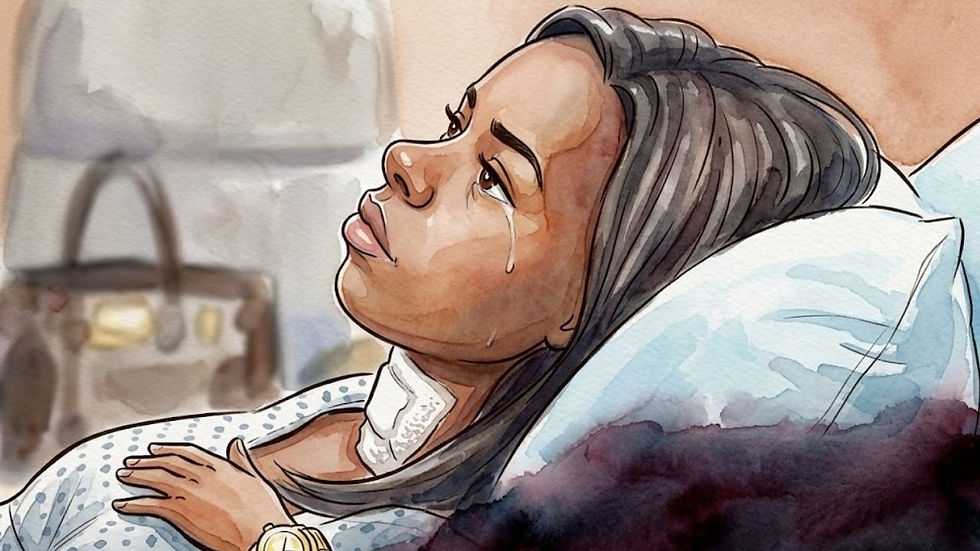
Camille, the Chief’s 17-year-old niece, lost consciousness during sex. She had a history of ovarian cancer three years prior and had one ovary removed. An ultrasound confirmed the cancer had returned and metastasized to her liver, lungs, and intestines.
Care Team
Addison Montgomery-Shepherd.
Treatment
Given the extensive metastasis, aggressive treatments like hysterectomy or chemotherapy were deemed ineffective, and the focus shifted to comfort care.
What was done wrong
The patient ignored severe symptoms (abdominal pain and nausea) for over a month because she did not want to be "the girl with cancer again" at her prom.
What was done right
Dr. Addison Montgomery-Shepherd used ultrasound and pelvic exams to correctly identify the recurrence. Most importantly, the medical team made the correct modern decision to prioritize palliative care over aggressive, futile surgeries (like a total hysterectomy) once it was determined the cancer was terminal and widely metastasized.

Self-Inflicted Gunshot Wound
Diagnosis
Gunshot wound (Head).
Definition
A traumatic brain injury caused by a projectile; in head wounds, the prognosis depends on the path of the bullet and damage to vital brain structures.
Patient
Petey.
Case Summary
The individual who shot Dr. Burke subsequently turned the gun on himself. He was brought into the ER with a weak pulse and was resuscitated by Dr. Yang before being moved to the OR, where he eventually died.
Care Team
Cristina Yang and Jeremy Bennett.
Treatment
Attempted resuscitation with Epinephrine and emergency surgery.
What was done wrong
The ER was in a state of chaos, with some staff viewing the patient as a "lost cause" due to his actions.
What was done right
Despite the emotional circumstances, Cristina Yang followed standard trauma protocol by resuscitating the patient in the ER and administering epinephrine (epi). Modern medical ethics dictate that all patients receive life-saving care regardless of their history.

Brain Death (The Donor)

Diagnosis
Brain death.
Definition
The irreversible loss of all functions of the entire brain, including the brainstem.
Patient
Unnamed Organ Donor.
Case Summary
This patient was maintained on life support specifically for organ harvesting. There was a delay in the procedure while UNOS and the hospital determined which recipient would receive the heart.
Care Team
Erica Hahn and Alex Karev.
Treatment
Maintenance on life support followed by organ harvest.
What was done wrong
There was a significant delay in harvesting the heart because the surgical teams were arguing over the recipient's status. In a real-world scenario, such delays can compromise the viability of the donor organ.
What was done right
The team adhered to strict UNOS time limits, with Dr. Hahn insisting on harvesting the organ once the allotted hour had passed to ensure the heart was not wasted.

Metastatic Canine Cancer
Diagnosis
Canine Cancer (Metastatic to the brain).
Definition
Malignant tumors in dogs that can spread to distant organs, including the brain, leading to seizures and neurological decline.
Patient
Doc (The Dog).
Case Summary
Doc, the dog shared by Meredith and Derek, suffered a seizure due to cancer spreading to his brain. After realizing his condition was terminal, the owners decided to end his suffering.
Care Team
Finn Dandridge (Veterinarian), Derek Shepherd, and Meredith Grey.
Treatment
Euthanasia via Terazole and Fenobarbital.
What was done right
After the dog suffered a seizure, the veterinary and medical owners (Meredith and Derek) correctly decided on humane euthanasia using phenobarbital to end his suffering.

🔖 Key Takeaways
🗝️ A chaotic ER shift showcases high-risk trauma, including a gunshot-induced brachial plexus injury requiring complex surgical intervention.
🗝️ The LVAD sabotage represents one of the most severe ethical violations, leading to a heart transplant under morally compromised circumstances.
🗝️ Accurate medical practices—like adenosine use and awake neurosurgery—contrast sharply with reckless intern decisions.
🗝️ Terminal ovarian cancer and metastatic disease emphasize the importance of palliative care over aggressive treatment.
🗝️ Despite emotional bias, doctors uphold medical ethics by treating all patients equally, including a self-inflicted gunshot case.
🗝️ Organ donation protocols highlight the critical balance between timing, ethics, and life-saving coordination.
🗝️ The episode blends strong clinical realism with dramatic ethical failures, making it one of the most intense season finales.
Keywords: Grey's Anatomy S2E26
Grey's Anatomy S2E26


Comments