

Grey's Anatomy TV Series Medical Review (S2E27)
- Mar 29
- 6 min read
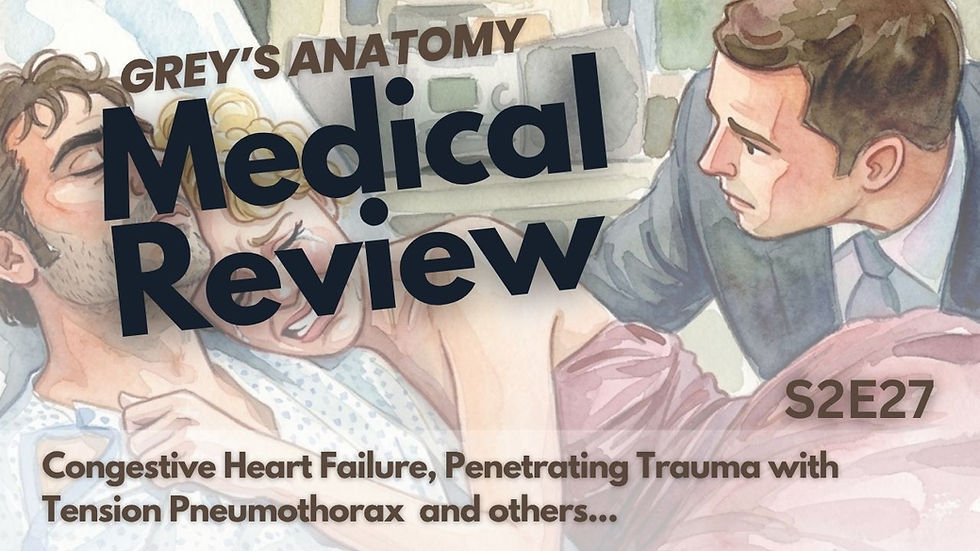
Welcome to a shift that is more "dark and twisty" than a standard Tuesday at Seattle Grace. Listen up, because today’s rounds are a masterclass in how clinical presentation can be masked by drama, and why "losing your distance" as a surgeon usually ends in a HR nightmare—or worse. We had a trauma room that looked like a war zone and a cardiac floor that was basically a crime scene.
Our shift started with a high-stakes mechanical failure; a patient with a long-standing history of end-stage cardiac failure presented with a severely compromised ventricular assist device and no detectable pulse. While we were managing that, a gunshot victim arrived with a wound to the right superior shoulder, presenting with hemodynamic instability, absent breath sounds on the right, and concerning neurological deficits in the distal extremity. Simultaneously, a 17-year-old female was brought in following a syncopal episode during intercourse; she had been experiencing a month of unspecified malaise following a history of oncological surgery. Finally, we managed a self-inflicted gunshot wound to the head and a canine patient presenting with seizures and neurological decline.

Congestive Heart Failure
(leading to Embolic Stroke)
Diagnosis
Congestive Heart Failure (CHF) and Acute Ischemic Stroke.
Definition
CHF is a chronic, progressive condition where the heart muscle is unable to pump enough blood to meet the body's needs for blood and oxygen; it can be caused by CAD, hypertension, or valvular disease. An ischemic stroke occurs when a blood clot (embolus) obstructs an artery leading to the brain, often triggered post-operatively in cardiac patients by dislodged mural thrombi or suture-line clots.
Patient
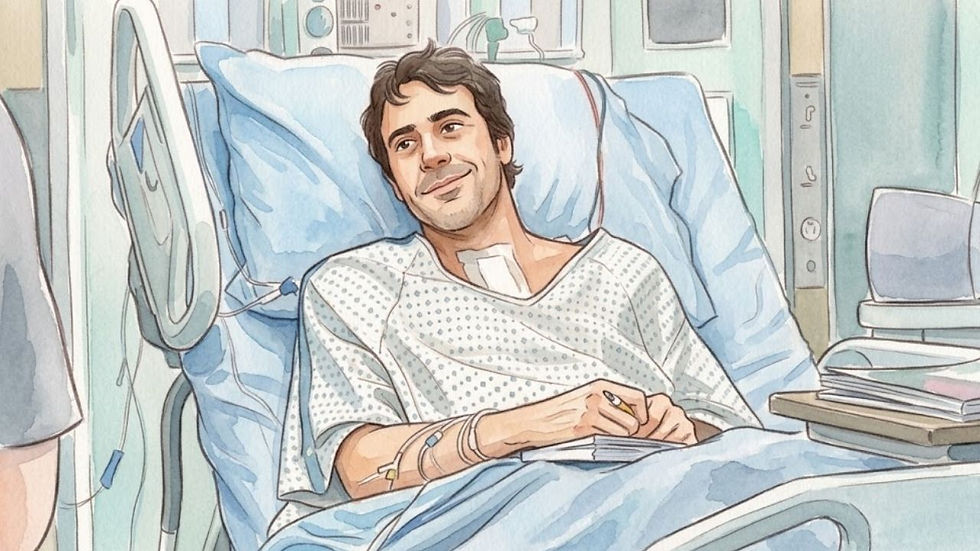
Denny Duquette, Jr.
Case Summary
Denny’s Left Ventricular Assist Device (LVAD) wires were intentionally severed by an intern to artificially worsen his condition and move him up the transplant list. He briefly entered Supraventricular Tachycardia (SVT) with a heart rate of 217 before being stabilized with Adenosine. He successfully underwent a heart transplant. However, hours later, he died suddenly, likely from an apoplexy or embolic stroke caused by a clot traveling from his suture line to his brain.
Care Team
Dr. Erica Hahn (Attending), Dr. Miranda Bailey (Resident), and Interns Isobel Stevens, Alex Karev, George O'Malley, Meredith Grey, and Cristina Yang.
Treatment
Heart transplant surgery, preceded by emergency chemical cardioversion (Adenosine) and manual heart pumping.
What They Did Wrong
The most egregious medical and ethical error was Izzie Stevens deliberately cutting Denny’s LVAD (Left Ventricular Assist Device) wire. This was done to intentionally worsen his condition so he would move to the top of the UNOS transplant list. Following this, the interns attempted to manage his crashing vitals—including treating supraventricular tachycardia (SVT) with adenosine—without a supervising attending present, which is a significant breach of hospital protocol.
What They Did Right
The heart transplant itself was technically successful; the new heart began beating on its own after being removed from bypass. Denny's death was caused by a post-operative stroke resulting from a blood clot that dislodged from his suture line. While modern medicine uses aggressive anticoagulation (blood thinners) to prevent such clots, strokes remain a known and serious risk of major cardiac surgery today.

Gunshot Wound with Brachial Plexus Injury
Diagnosis
Penetrating Trauma with Tension Pneumothorax, Subclavian Artery Pseudoaneurysm, and Brachial Plexus Injury.
Definition
A gunshot wound to the shoulder can cause a "triple threat" of injury: pulmonary (collapsed lung due to air in the pleural space), vascular (a pseudoaneurysm, or "false aneurysm," where a hematoma forms outside the arterial wall), and neurological (damage to the brachial plexus, the nerve network providing movement and sensation to the arm).
Patient
Dr. Preston Burke.
Case Summary
Dr. Burke arrived with a GSW to the right shoulder. He immediately developed a collapsed lung (tracheal shift and absent breath sounds), which was managed in trauma. Follow-up imaging revealed a pseudoaneurysm in the subclavian artery compressing the brachial plexus, causing numbness in his fourth and fifth fingers. After a precarious surgery, he regained finger mobility but later developed a tremor.
Care Team
Dr. Derek Shepherd (Neurosurgeon) and Dr. Richard Webber.
Treatment
Needle decompression/chest tube for the pneumothorax, followed by surgery to repair the pseudoaneurysm and relieve nerve pressure.
What They Did Wrong
There was a period of observation rather than immediate surgery for his pseudoaneurysm, which carried the risk of the aneurysm growing and causing further damage. Additionally, after the surgery, Burke developed a hand tremor that was not immediately addressed or disclosed to the full surgical team.
What They Did Right
The team correctly used angiography to locate the bullet and assess vascular damage to the subclavian artery. During and after the neurosurgical repair of the brachial plexus, Dr. Shepherd used a standard "touch each finger to thumb" test to assess nerve function and motor control, which remains a primary clinical method for evaluating nerve recovery today.

Recurrent Ovarian Cancer (Metastatic)

Diagnosis
Recurrent Metastatic Ovarian Cancer.
Definition
Ovarian cancer is often called the "silent killer" because it is frequently asymptomatic until it reaches an advanced stage. Recurrence after initial surgery (like a unilateral oophorectomy) often manifests as widespread peritoneal seeding or distant metastasis to the liver, lungs, and intestines, carrying a poor prognosis.
Patient
Camille Travis.
Case Summary
Camille, the Chief's niece, fainted during sex. Evaluation of her month-long malaise revealed that her ovarian cancer, previously treated three years ago, had returned and spread aggressively to her liver, lungs, and intestines. Due to the extent of the metastasis, the team determined the condition was terminal.
Care Team
Dr. Addison Montgomery (OB/GYN) and the intern team (Grey, Karev, O'Malley, Yang, Stevens).
Treatment
Palliative care; the surgical team was assigned to fulfill her request for a hospital-based prom.
What They Did Wrong
From a management perspective, the Chief of Surgery allowed his personal relationship with the patient (his niece) to override standard hospital operations by assigning five surgical interns to act as event planners for a hospital prom rather than focusing on medical duties.
What They Did Right
Dr. Addison Montgomery-Shepherd accurately diagnosed the extensive metastasis of Camille's cancer to her liver, lungs, and intestines. Recognizing that aggressive treatments like further surgery or chemotherapy would not be effective, the team shifted toward palliative care. Modern oncology places a heavy emphasis on the "quality of life" for terminal patients, and while a hospital-wide prom is unusual, the focus on psychological well-being is consistent with current end-of-life care standards.

Traumatic Brain Injury (Self-Inflicted GSW)
Diagnosis
Self-inflicted Gunshot Wound to the Head.
Definition
High-velocity penetrating trauma to the cranium usually results in catastrophic brain tissue destruction, intracranial hemorrhage, and immediate or rapid cessation of vital functions.
Patient
The Shooter (Unnamed).
Case Summary
After shooting Dr. Burke, the assailant turned the gun on himself. He arrived with a weak pulse and massive cranial trauma. Despite the grim prognosis, Intern Cristina Yang insisted on aggressive resuscitation (Epinephrine/compressions) to ensure the team "did everything" before calling it.
Care Team
Dr. Cristina Yang.
Treatment
ACLS protocol, including Epinephrine and cardiac monitoring.
What They Did Wrong
Cristina Yang displayed extreme professional bias and hostility, openly calling the patient a "miserable life" and treating the resuscitation as a burden. In modern medicine, maintaining professional neutrality and providing equal care regardless of a patient's history is a fundamental ethical requirement.
What They Did Right
Despite the personal bias, the medical team still followed standard trauma protocols, including administering Epinephrine ("epi") and placing the patient on a monitor to attempt to stabilize the self-inflicted head wound.

Metastatic Canine Neoplasia

Diagnosis
Metastatic Cancer with Brain Involvement.
Definition
In canines, cancer (such as osteosarcoma or hemangiosarcoma) can metastasize to the brain, leading to neurological symptoms, including seizures and altered mentation.
Patient
Doc (The Dog).
Case Summary
Doc presented with a seizure. His veterinarian, Finn Dandridge, confirmed the cancer had spread to his brain. Given his suffering and poor prognosis, the owners opted for humane euthanasia.
Care Team
Finn Dandridge (Veterinarian), Meredith Grey, and Derek Shepherd.
Treatment
Humane euthanasia via Terazole (sedative) and Phenobarbital.
What They Did Right
The decision to euthanize the dog using terazole for sedation, followed by a fenobarbital injection to stop the heart, is the standard, compassionate procedure used by veterinarians today to end animal suffering in terminal cases.

🔖 Key Takeaways
🗝️ A catastrophic LVAD sabotage triggers a successful transplant but ends in a fatal post-operative stroke, highlighting ethical collapse and surgical risk.
🗝️ A complex gunshot injury reveals pneumothorax, vascular damage, and brachial plexus trauma, showcasing both sharp diagnostics and delayed decisions.
🗝️ Metastatic ovarian cancer shifts focus from treatment to palliative care, emphasizing quality of life over aggressive intervention.
🗝️ A self-inflicted GSW exposes emotional bias in care, testing professional ethics under extreme pressure.
🗝️ Even a canine cancer case reinforces compassion and humane end-of-life decisions in medical practice.
Keywords: Grey's Anatomy S2E27
Grey's Anatomy S2E27


Comments