

Grey's Anatomy TV Series Medical Review (S3E11)
- Apr 6
- 6 min read

Grab your scrub caps and a double-shot latte—no vanilla, unless you’re trying to poison me like Karev—because the boards at Seattle Grace are stacked today. We’ve got a "dark and twisty" mix of cases that would make even a jaded Attending break a sweat.
We’re looking at a 63-year-old male who just survived a heart valve replacement but is now facing a massive GI hurdle. Down in the Peds ICU, a four-day-old neonate is struggling with post-op abdominal distension that’s looking more ominous by the hour. Then we have a 17-year-old whose anatomy is a literal puzzle; her spine is curved at 90 degrees, and her ribs are essentially suffocating her lungs. And finally, one of our own is stuck in a hospital gown, recovering from a delicate neurosurgical procedure to save his billion-dollar hands, though the real drama is the "silent treatment" happening at his bedside.
Let’s hit the floor and see what "The Science" tells us about these patients.

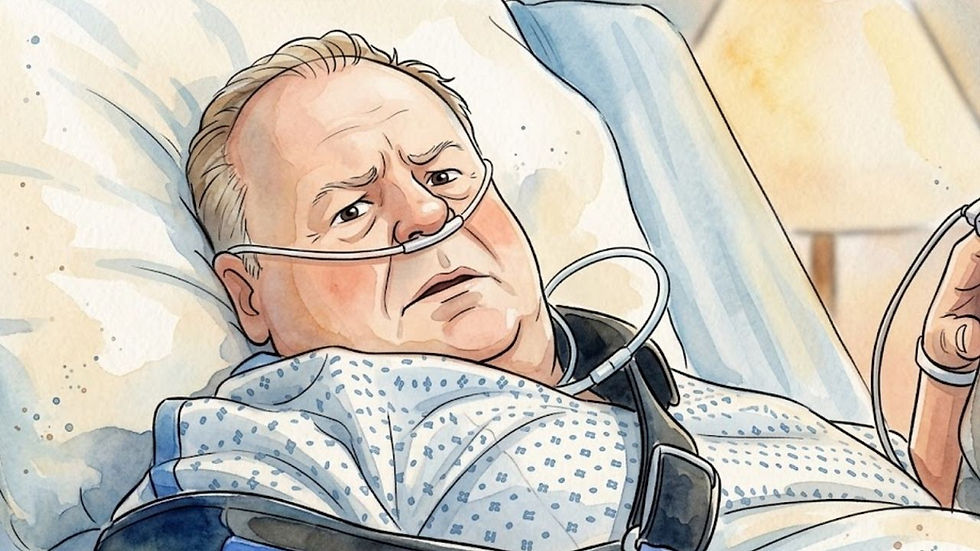
Stage II Metastatic Esophageal Cancer
Diagnosis
Stage II Metastatic Esophageal Cancer
Definition
A malignancy arising from the mucosal lining of the esophagus. Stage II typically involves the tumor invading deeper layers of the esophageal wall with potential regional lymph node involvement. Prognosis is generally guarded, and "metastatic" indicates the spread of malignant cells to distant organs or tissues, significantly complicating surgical outcomes.
Patient
Harold O'Malley.
Case Summary
Harold, father of one of our residents, was admitted for a transhiatal esophagectomy following a previous aortic valve replacement. Despite the oncology team warning that extensive spread might halt the procedure, Harold demanded the surgeons "remove the tumor no matter what". Upon opening him up, the team found widespread metastases in the stomach, liver, and celiac lymph nodes. Honoring the patient’s request, they proceeded with the resection. Post-operatively, the primary concern is multi-system organ failure, specifically monitoring renal function as the first indicator of systemic collapse.
Care Team
Richard Webber (General Surgeon), Miranda Bailey (Surgical Resident), Meredith Grey (Surgical Intern), and an unnamed oncologist.
Treatment
Transhiatal esophagectomy.
What they did wrong
The most significant medical and ethical error was the surgeons’ decision to proceed with a transhiatal esophagectomy despite finding extensive metastases. When Richard Webber opened the patient, he discovered the cancer had spread to the stomach, celiac lymph nodes, and the liver. In modern medical practice, performing such a high-morbidity surgery (which had a 50% morbidity rate in this case) on a patient with widespread Stage IV cancer is generally contraindicated, as the surgical trauma often outweighs any palliative benefit. Furthermore, the doctors entered into a private agreement with the patient to remove the tumor "no matter what," which compromises clinical judgment and the requirement to act in the patient's best medical interest once new intraoperative information is discovered.
What they did right
The medical team correctly identified the primary risks of such an intensive surgery, specifically multi-system organ failure. Their focus on monitoring urine output to check renal function was a standard and appropriate clinical practice to catch the first signs of organ failure.

VATER Syndrome
Diagnosis
VATER Syndrome (with associated Severe Scoliosis and Nephrolithiasis)
Definition
A non-random association of birth defects. VATER is an acronym: Vertebral anomalies, Anal atresia, Tracheoesophageal fistula, Esophageal atresia, and Renal/Radial anomalies. Patients often face a lifetime of corrective surgeries. Prognosis depends on the severity of the organ involvement.
Patient
Heather Douglas.
Case Summary
At 17, Heather has already endured multiple failed spinal fusions. She presented with kidney stones and ribs that were compressing her lungs due to a 90-degree spinal curvature. While she was scheduled for minor procedures to improve her immediate quality of life, Dr. Shepherd proposed an experimental, radical reconstruction: removing a portion of her spine and replacing it with a titanium mesh cage. However, the $200,000 price tag for this "experimental" surgery led to an insurance denial, leaving the definitive treatment in limbo.
Care Team
Derek Shepherd (Neurosurgeon), Callie Torres (Orthopedic Resident), Miranda Bailey (Surgical Resident), and Izzie Stevens (Surgical Intern).
Treatment
Lithotripsy for kidney stones and thoracoplasty (rib removal); experimental titanium mesh cage reconstruction was proposed but denied by insurance.
What they did wrong
While not a direct clinical error, there was a potential lapse in informed consent when Derek Shepherd initially told the patient he could "place her straight" before fully detailing the risks of paralysis or death, which he only clarified after her mother's prompting. Additionally, the treatment plan relied on an experimental procedure—removing a portion of the spine and replacing it with a titanium mesh cage—without having a finalized payment or insurance plan in place, leading to the surgery being canceled when the insurance company deemed it too experimental to cover.
What they did right
The team correctly diagnosed VATER syndrome, a rare genetic condition affecting multiple systems, including the vertebrae and kidneys. Using lithotripsy to treat her kidney stones and thoracoplasty to relieve pressure on her lungs from her severe 90-degree scoliosis are both standard and effective treatments for improving quality of life in complex cases.

Bowel Perforation

Diagnosis
Bowel Perforation (secondary to Jejunal Atresia and Nasogastric Tube trauma)
Definition
A full-thickness hole in the wall of the gastrointestinal tract. In neonates, this can lead to pneumoperitoneum (air in the abdominal cavity), sepsis, and rapid clinical decline. Causes include ischemia, infection, or mechanical trauma from medical devices like nasogastric tubes.
Patient
Laura Grey-Thompson.
Case Summary
Only four days old, Laura was recovering from a surgical correction of jejunal atresia. She developed post-operative bowel dilation, and a subsequent X-ray revealed the dreaded "free air" under the diaphragm. During an emergency laparotomy, it was discovered that a nasogastric tube had actually perforated the wall of her stomach. The team had to resect a portion of the stomach and intestine to save her life.
Care Team
Addison Forbes Montgomery (Neonatal Surgeon) and Meredith Grey (Surgical Intern).
Treatment
Barium enema (diagnostic) followed by emergency surgical resection of the perforated bowel and stomach segments.
What they did wrong
The patient suffered an iatrogenic injury, which is an injury caused by medical treatment. During her care, a nasogastric (NG) tube perforated the wall of her stomach. While neonatal tissues are delicate, this is considered a significant complication of a routine procedure.
What they did right
The doctors were highly observant during post-operative monitoring. They correctly identified abdominal distention and used a barium enema and X-rays to check for bowel issues. Once they identified air under the diaphragm—a classic sign of perforation—they acted immediately to take the infant back into surgery, which is the correct lifesaving protocol for a bowel perforation.

Post-Operative Compressive Hematoma Recovery
Diagnosis
Post-Surgical Recovery from Brachial Plexus Compressive Hematoma
Definition
A collection of blood (hematoma) that exerts pressure on the brachial plexus—the network of nerves supplying the shoulder, arm, and hand. This compression can cause pain, loss of sensation, and motor dysfunction (tremors or paralysis). Surgical "I&D" (Incision and Drainage) is required to relieve the pressure.
Patient
Preston Burke.
Case Summary
Dr. Burke is on the other side of the stethoscope this week, recovering from an I&D of a compressive hematoma on his brachial plexus. While his vitals are stable and his incisions are clean, the million-dollar question remains: the tremors. He is currently in the post-op monitoring phase, though he is being uncharacteristically guarded about his actual neurological progress with his team—and his girlfriend.
Care Team
Derek Shepherd (Neurosurgeon) and Alex Karev (Surgical Intern).
Treatment
Incision and Drainage (I&D) of the hematoma and post-operative neurological monitoring.
What they did wrong
The primary issue in Burke's case was a breach of professional boundaries and confidentiality. His girlfriend (Cristina Yang) and other colleagues provided direct care to him. They were actively seeking or sharing confidential information about his hand tremors, which complicates the standard of objective medical care.
What they did right
His post-operative care followed standard protocols, including monitoring for fever, stable vital signs, and ensuring the incision sites remained clean and free of infection following the removal of a compressive hematoma from his brachial plexus.

🔖 Key Takeaways
🗝️ Grey’s Anatomy S3E11 review presents multiple high-risk cases, emphasizing the complexity of surgical decision-making and patient outcomes.
🗝️ The esophageal cancer storyline highlights ethical conflicts, showing how performing surgery despite metastasis can contradict modern medical standards.
🗝️ The VATER syndrome case explores experimental treatment challenges, including informed consent issues and insurance barriers in life-altering procedures.
🗝️ Neonatal bowel perforation underscores the risks of iatrogenic injuries while reinforcing the importance of rapid diagnosis and emergency intervention.
🗝️ Burke’s recovery storyline focuses on post-operative complications, professional boundaries, and the emotional strain of secrecy within medical teams.
🗝️ Overall, the episode blends medical realism with drama, showcasing how ethical dilemmas and clinical risks shape outcomes at Seattle Grace Hospital.
Keywords: Grey's Anatomy S3E11
Grey's Anatomy S3E11


Comments